Wagering requirements explained honestly has to begin with the admission almost no bonus page makes: the multiplier is not the number that decides what the offer is worth. Pages on this topic publish the headline term 35x, 40x, 50x and treat it as a difficulty dial, as though a lower number were automatically a better deal. It is not. A multiplier only tells you how much turnover you have to generate. It says nothing at all about what generating that turnover costs, and cost is the entire question.
Two offers with identical 35x terms can differ by a factor of four in expected cost, depending purely on which games the turnover runs through. This breakdown does the arithmetic those pages skip: it multiplies a requirement through a house-edge game with illustrative numbers, shows how much of a bonus mathematically survives, and takes apart the two clauses — the deposit-plus-bonus base and game weighting — that quietly do more damage than the multiplier ever does. Nothing here is a method for beating anything. The maths points the other way, and saying so is the point.
Table of Contents
Wagering requirements explained: turnover is not spend
Start with the distinction that gets collapsed everywhere else: turnover is not spend. If you place a 10-unit stake and it resolves, you have generated 10 units of turnover. You have not lost 10 units — you have lost, on average, 10 units multiplied by the house edge of that game. The rest comes back as winnings, which you then stake again, generating more turnover, losing a slice again. Turnover is the odometer. Loss is the fuel burn. A wagering requirement is written in odometer units, which is exactly why it looks survivable.
So the honest formula has three inputs, not one. The multiplier, the base it applies to, and the house edge of the game the turnover runs through. Change any of the three and the answer moves. Bonus pages publish the first, bury the second in a subclause, and never mention the third — because the third is the one that turns a promotion into an expected cost.
The reason this matters is not that some clever combination makes bonuses profitable. It is that the arithmetic tells you, before you accept anything, roughly what fraction of a bonus is already gone by the time the requirement clears. Sometimes that fraction is modest. Often it is more than one hundred per cent, meaning the expected cost of completing the requirement exceeds the bonus itself. Both outcomes are worth knowing in advance, and neither is visible from the multiplier alone.
It also explains why the subject is persistently confusing to read about. Three different quantities travel under loose language — the amount credited, the amount that must be staked, and the amount expected to be lost in the staking — and promotional copy tends to name only the first and the second. The third is never printed anywhere, because it is not a term at all. It is a consequence of the terms, and it has to be calculated. That calculation is the only thing on this page that is not already somewhere in the small print.
If you want the underlying mechanic before the bonus layer goes on top, the companion breakdown of how the house edge is built into every game’s rules covers where that percentage actually comes from. The bonus arithmetic here simply borrows that number and multiplies it by a much larger amount of turnover than a player would otherwise generate.
What does a 35x wagering requirement mean?
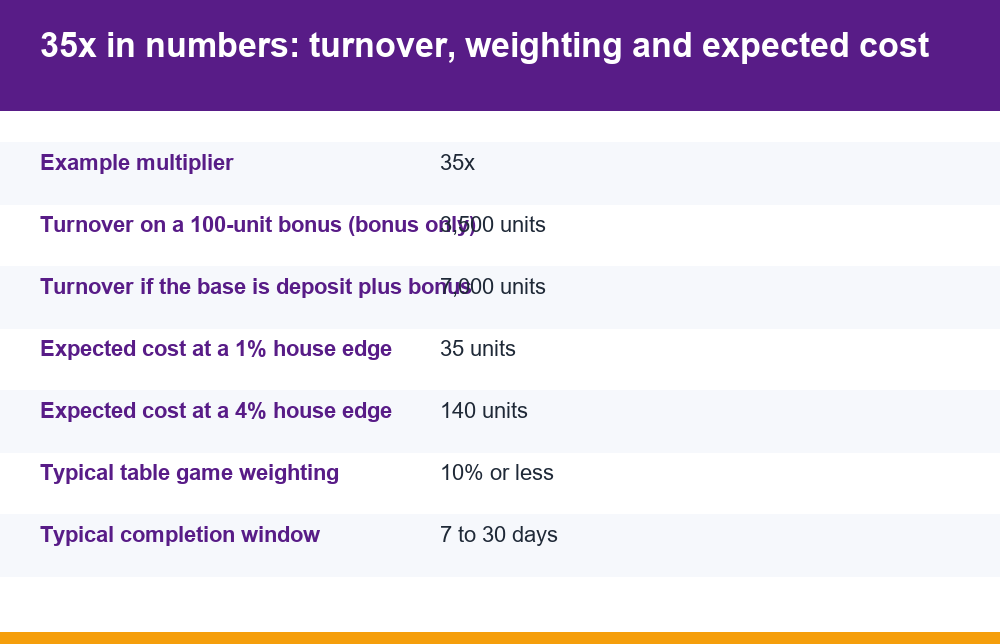
A 35x wagering requirement means the qualifying amount must be staked thirty-five times over before the balance tied to the offer can be treated as ordinary funds. On a 100-unit bonus with the requirement applied to the bonus alone, that is 3,500 units of cumulative turnover. The stakes can be any size the terms permit and spread over as many rounds as you like; what is counted is the running total of amounts staked, not the number of rounds and not your net position.
Three details are commonly misread, and all of them are in the terms rather than the headline:
- Only resolved stakes count. A wager that is voided, cancelled, refunded or returned as a push usually contributes nothing to the running total, even though money moved.
- Winning and losing stakes count identically. A 10-unit stake adds 10 units of progress whether it returns 0 or 200. The requirement is indifferent to results.
- Progress is a one-way counter, not a target to hit on a final bet. You do not need 3,500 units in your account. You need 3,500 units to have passed through stakes, which recycled winnings do most of the work for.
- The counter does not reverse. A losing run does not undo progress already recorded, which is why a requirement can be cleared by an account that has nothing left in it — completion and solvency are separate conditions.
That third point is why 35x reads as reasonable. A 100-unit balance can generate 3,500 units of turnover without anything dramatic happening, because the same money is restaked repeatedly. What people notice is the time it takes. What they rarely quantify is the steady leak underneath: every pass through the cycle shaves off the edge, and 3,500 units of turnover means the edge is applied to 3,500 units, not to 100.
It is worth being precise about the units too. Everything on this page is written in abstract units rather than any currency, because the arithmetic is scale-free: a 35x requirement behaves identically whether the base is a hundred of something or a hundred thousand of it. That also keeps the numbers from being read as a quoted offer. They are not. They are illustrations of a formula.
Why the multiplier alone cannot tell you anything
A 20x requirement on a game with a 5 per cent edge costs more in expectation than a 50x requirement on a game with a 1 per cent edge — 100 units of expected loss against 50, on the same 100-unit base. Ranking offers by multiplier therefore ranks them by the wrong variable. Any comparison that does not state the edge of the eligible games is incomplete, no matter how confidently it is presented.
The same applies to the word rollover, which is used interchangeably with wagering requirement in a lot of copy. It is the same mechanic under a different label, and the label change does nothing to the arithmetic. Where the two terms differ at all, it is in which products they tend to be attached to rather than in how the obligation is computed.
Is wagering applied to the bonus or the deposit plus bonus?
It depends entirely on the wording, and this single clause is the largest swing factor in the whole document. Two bases are in common use. Bonus only applies the multiplier to the credited bonus amount. Deposit plus bonus applies it to your own money and the bonus added together, which on a matched offer doubles the base — and therefore doubles the turnover, and therefore doubles the expected cost.
On a 100-unit deposit matched with a 100-unit bonus at 35x, the bonus-only reading produces 3,500 units of turnover. The deposit-plus-bonus reading produces 7,000. Same headline number, same offer size, twice the obligation. Nothing on the promotional banner distinguishes them. The phrasing in the terms does, and it is usually a single preposition:
- “35x the bonus amount” — base is the bonus. Turnover of 3,500 on a 100-unit bonus.
- “35x the bonus” with a separate line defining bonus funds — check whether that definition silently includes the deposit.
- “35x (deposit + bonus)” or “35x the total of your deposit and bonus” — base is doubled on a matched offer.
- “35x the deposit amount” — base is your own money, which on a partial-match offer can be larger than the bonus itself.
- “turnover of 35x the qualifying amount” — ambiguous until “qualifying amount” is defined elsewhere in the document; it almost always is, further down.
The practical consequence is that a 20x deposit-plus-bonus requirement and a 40x bonus-only requirement are the same obligation on a one-to-one match. The first looks half the size. This is the trap, and it is not a trick so much as a disclosure problem: the comparison tables that rank offers by multiplier are comparing numbers that do not share a denominator.
There is a third variant that sits between the two and is easy to miss. Some documents apply the multiplier to the bonus but define the qualifying deposit as a separate minimum that must also be staked a stated number of times before withdrawal. That is two obligations rather than one, and they are additive. The headline multiplier describes only the first of them.
When the same structure is attached to a sports account rather than a casino lobby, the mechanics travel with it — the breakdown of how casino bonus terms show up on cricket-facing accounts looks at the same clauses in that setting, including the ones that cut across both products.
Why do table games count less towards wagering?
Because the house edge differs by game, and the weighting schedule exists to equalise the expected cost of clearing the requirement. A game with a low edge returns most of the stake in the long run, so turnover generated on it is cheap for the player — which means a lot more of it is required. Weighting is how that adjustment is applied: it says how much of each unit staked is credited to your running total.
At 100 per cent weighting, a 10-unit stake adds 10 units of progress. At 10 per cent, the same stake adds 1 unit. At 0 per cent it adds nothing at all, and some schedules go further by making the game outright ineligible, so stakes there can void the bonus rather than merely fail to advance it. Typical published schedules, in general terms rather than from any particular source, look like this:
- Slots and most instant-win formats: often 100 per cent, because the edge is comparatively high.
- Video poker and low-edge card formats: frequently 10 to 20 per cent, sometimes excluded.
- Roulette variants: commonly 10 to 50 per cent, occasionally split by variant.
- Blackjack and baccarat: often 10 per cent or less, and among the most commonly excluded entirely.
- Live dealer tables: usually weighted lower than the equivalent software version, or excluded outright.
Run the consequence through. A 3,500-unit requirement on a 10 per cent weighted table game needs 35,000 units of actual stakes. Even at a 1 per cent edge, 35,000 units of turnover carries an expected cost of 350 units — three and a half times the 100-unit bonus. The low edge that made the game attractive is cancelled, with interest, by the weighting that was applied because of it. Weighting is not a penalty on skill; it is the arithmetic refusing to let the edge be arbitraged.
This is also the step that makes weighting the single most under-read line in a bonus document. The multiplier is a number you can hold in your head. The weighting schedule is a table, often on a separate page, and dividing by it changes the answer by an order of magnitude. A reader who notes 35x and ignores a 10 per cent weighting has understated the obligation by a factor of ten, which is a far larger error than any difference between 35x and 50x.
The relationship between that percentage and what a game returns over time is set out in the breakdown of what return-to-player figures do and do not promise, which is the same number viewed from the other side.
The weighting clause to read twice
Some schedules apply weighting to progress, as described above. A smaller number apply it to eligibility — stakes on a weighted-down game count partially, but any winnings from them are capped or removed at the point of withdrawal. Those are different mechanics with different arithmetic, and they are described in near-identical language. The distinction is worth finding before accepting, not after.
How much of a bonus is left after the wagering is complete?
In expectation, less than the bonus — and frequently nothing. This is the calculation bonus pages do not run, so here it is with illustrative figures. The method is simple: turnover equals multiplier times base, divided by weighting. Expected cost equals turnover times the house edge. Expected remainder equals bonus minus expected cost. Every number below is an illustration of the arithmetic, not a measurement of any actual offer.
| Multiplier and base | Turnover required | House edge | Expected cost | Expected bonus remaining |
|---|---|---|---|---|
| 35x on a 100-unit bonus | 3,500 units | 1% | 35 units | 65 units |
| 35x on a 100-unit bonus | 3,500 units | 2.5% | 87.50 units | 12.50 units |
| 35x on a 100-unit bonus | 3,500 units | 4% | 140 units | nothing (40 units short) |
| 35x on deposit plus bonus (200) | 7,000 units | 2.5% | 175 units | nothing (75 units short) |
| 35x on deposit plus bonus (200) | 7,000 units | 4% | 280 units | nothing (180 units short) |
| 20x on a 100-unit bonus | 2,000 units | 4% | 80 units | 20 units |
| 50x on a 100-unit bonus | 5,000 units | 2.5% | 125 units | nothing (25 units short) |
| 35x at 10% weighting (100-unit bonus) | 35,000 units | 1% | 350 units | nothing (250 units short) |
Read down the expected-cost column and the pattern is unmistakable. Wherever the product of the multiplier and the house edge exceeds 1, the expected cost of clearing the requirement is larger than the bonus. At a 4 per cent edge, the break-even multiplier is 25x on a bonus-only base. Anything above that is, in expectation, a net cost dressed as a gift. At a 1 per cent edge the break-even point is 100x — which is precisely why low-edge games are weighted down to 10 per cent, pushing the effective multiplier back above it.
That break-even rule is the whole of it in one line, and it is why having wagering requirements explained in arithmetic rather than adjectives changes what the terms look like. Multiplier times edge below 1 leaves something on the table. Multiplier times edge above 1 does not. No amount of favourable phrasing moves that threshold, and the figures needed to work out which side of it an offer falls on are all present in the document — just never multiplied together.
Two caveats keep this honest in both directions. First, expectation is not a forecast of any single attempt: variance is wide, individual outcomes scatter heavily around these figures, and some players will finish ahead. Second, the figures ignore every other clause — maximum cashout, maximum stake while wagering, excluded games — and each of those can only reduce the remainder, never increase it. The arithmetic above is the optimistic case.
What the table does not show, because it cannot, is a configuration where the numbers favour the player. There is no multiplier, base and weighting combination that produces a positive expectation against a house edge, because the edge is applied to every unit of turnover the requirement demands. More turnover is always more cost. That is the whole mechanism, and it is why no staking pattern or game-selection scheme changes the conclusion — the margin is charged on volume, and the requirement is a volume mandate.
What happens if the bonus expires before wagering is finished?
Typically the bonus balance and anything attributed to it are removed, and the account returns to whatever remains of your own deposited funds. The usual windows run from seven to thirty days from credit, sometimes shorter for free-spin style offers. Partial progress almost never carries any value: clearing 90 per cent of a requirement and 0 per cent are treated the same way at expiry, because the condition is binary.
The detail that catches people out is which funds get removed. Where bonus and deposit money are pooled into a single balance, the terms define an accounting order — and that definition decides whether winnings accumulated during the period are yours or the bonus’s. Common variants include:
- Bonus and associated winnings forfeited. Everything traceable to the bonus is removed; your remaining own funds stay.
- Bonus forfeited, winnings retained up to a cap. A fixed ceiling applies, often expressed as a multiple of the bonus.
- Whole balance forfeited. Where funds were pooled and no separation is maintained, the entire balance can be treated as bonus-derived.
- Deposit spent first. Your own money is consumed before the bonus is touched, so by expiry there is often little of it left to return.
That last clause deserves attention, because it is the quiet one. If deposited funds are staked before bonus funds, then by the time a requirement fails you have already spent your own money and are forfeiting a bonus you never got to use. Expiry then costs the deposit, not the bonus. The order of consumption is stated in the terms, usually in a single sentence, and it changes the outcome more than the deadline does.
The window interacts with the stake cap in a way that is worth checking before accepting rather than discovering on day six. A requirement of 3,500 units, a cap of 5 units per round and a seven-day window implies at least 700 rounds inside a week. That is arithmetic, not advice, and it either fits or it does not. Where it does not fit, the offer is not difficult to complete — it is not completable, and the forfeiture rule is the only clause that will ever apply.
One honesty line, because it belongs here: real-money play is for adults only, it carries risk, and across any population of players losses are the expected outcome — that is what a house edge means. For plain-language background on gambling harm and where free, confidential support exists, GamCare’s awareness and education pages are a non-commercial starting point with no product attached.
The clauses that change the maths more than the multiplier
Once the multiplier, base and weighting are known, the remaining terms are what decide whether the arithmetic above is even reachable. These are the ones that do the most work for the least attention.
Maximum stake while wagering. A cap of a few units per spin or hand, applied to a requirement in the thousands, sets a floor on how long completion takes. More important, breaching it even once is commonly grounds for voiding the bonus and its winnings — and the breach can happen accidentally, through a feature that stakes more than the base amount. This clause turns a maths problem into a condition you can break without noticing.
Maximum cashout. A ceiling expressed as a multiple of the bonus, or a flat figure, truncates the right tail of the distribution. Since the bonus arithmetic is already negative in expectation across most configurations, the tail is where the few favourable outcomes live. Capping it removes the only part of the distribution that was working in the player’s favour, while leaving the expected cost untouched.
Sticky versus non-sticky bonus funds. A non-sticky bonus can be withdrawn once the requirement clears. A sticky bonus never can — only winnings above it are withdrawable, and the bonus amount is deducted at the end. For a sticky bonus, the “expected bonus remaining” column in the table above is not what you receive; it is the cushion you had while playing. That is a materially different product with the same name.
Excluded games and excluded features. Beyond weighting, specific titles, bet types and in-game features are commonly listed as ineligible. Hedged or low-variance bet combinations on table games are frequently named — betting both red and black on roulette, for instance, generates turnover at near-zero risk, so terms exclude it. Stakes placed on excluded content may void the bonus rather than simply failing to count.
One offer per person, household, device or payment instrument. This is an identity clause rather than a maths clause, but it is the one most often cited when a completed requirement is not paid out, because verification happens at withdrawal rather than at sign-up.
Why these clauses are easy to under-weight
Each of them is short. The multiplier is the only term with a number big enough to look like the main condition, so attention settles there and the one-sentence clauses read as boilerplate. In cost terms the ranking is close to reversed: the base and the weighting move the expected cost by multiples, the stake cap and the exclusion list decide whether the attempt survives at all, and the multiplier is comparatively the least informative figure on the page. Having wagering requirements explained in that order — base, weighting, caps, then multiplier — is simply reading the document in descending order of consequence.
A checklist for reading bonus terms line by line
This is a reading procedure, not a strategy. It produces a number — the expected cost of completing the requirement — so that an offer can be assessed before it is accepted rather than explained afterwards. Work in this order:
- Find the multiplier and the base in the same sentence. If the base is not named in the same clause, keep reading until it is defined. Do not assume bonus-only.
- Multiply. Multiplier times base gives the raw turnover. Write it down; it is usually an order of magnitude larger than it feels.
- Locate the weighting schedule. Divide the raw turnover by the weighting of the games you would actually use. This is the step most readers skip and it is often the largest multiplier of all.
- Apply the house edge. Weighted turnover times the edge gives the expected cost. Compare it to the bonus. If the cost is larger, the offer has a negative expected value before any other clause applies.
- Check the maximum stake while wagering. Divide the turnover by that cap to get a minimum number of rounds, then judge it against the expiry window. If the two are incompatible, the requirement is not completable regardless of the maths.
- Check the cashout cap and whether funds are sticky. These decide what a successful completion actually pays.
- Check the fund consumption order and the expiry forfeiture rule. These decide what a failed completion actually costs.
- Check whether a second obligation is hiding. A separate deposit-turnover condition, a minimum-odds rule, or a verification step can each sit outside the headline requirement entirely.
- Save the terms as they stood when you accepted. Published terms are versioned and can change; the version in force at acceptance is the one that described your obligation.
Run that sequence on a few offers and a consistent picture emerges. The multiplier correlates weakly with the expected cost. The base and the weighting correlate strongly. And the offers presented as the most generous — the largest match percentages, the biggest headline amounts — are frequently the ones with a deposit-plus-bonus base and an aggressive weighting schedule, because the arithmetic has to balance somewhere.
It is also worth noting what the checklist deliberately does not do. It does not pick games, sizes or sequences, because nothing in that direction alters the expected cost; the edge is charged per unit of turnover and the requirement fixes the turnover. The only variables a reader actually controls are whether to accept an offer at all and, once the numbers are on paper, whether the price is one they are willing to pay knowingly.
The conclusion is not that bonuses are a swindle. It is narrower and more useful than that: a wagering requirement is a turnover obligation, turnover carries a mathematically fixed cost, and a bonus is worth the difference between its face value and that cost. Sometimes the difference is positive and modest. Across the common configurations shown above, it is negative. Seeing wagering requirements explained in those terms does not make anyone better at playing — nothing does, because no system beats the margin. It makes the price legible before it is paid, which is the only honest thing a page on this subject can offer.
Frequently Asked Questions
What does a 35x wagering requirement mean?
It means the qualifying amount must be staked thirty-five times over before the funds tied to the offer are treated as ordinary money. On a 100-unit bonus with the requirement applied to the bonus alone, that is 3,500 units of cumulative turnover. Only resolved stakes count, winning and losing stakes count identically, and the total is a running counter rather than a balance you need to hold. Because recycled winnings generate most of that turnover, 35x feels manageable — but the house edge is charged on all 3,500 units, not on the original 100.
Is wagering applied to the bonus or the deposit plus bonus?
Both wordings exist and the difference is large. A bonus-only base on a 100-unit bonus at 35x means 3,500 units of turnover. A deposit-plus-bonus base on a matched 100-unit deposit means 35x of 200, or 7,000 units — double the obligation and double the expected cost, with no change to the headline multiplier. The distinction usually hangs on a single phrase such as “35x the bonus amount” versus “35x deposit plus bonus”, and it means a 20x deposit-plus-bonus requirement equals a 40x bonus-only one on a one-to-one match.
Why do table games count less towards wagering?
Because their house edge is lower, so turnover generated on them costs the player less — and the weighting schedule exists to equalise that. At 10 per cent weighting, a 10-unit stake credits only 1 unit of progress, so a 3,500-unit requirement needs 35,000 units of actual stakes. At a 1 per cent edge that carries an expected cost of around 350 units, far more than a 100-unit bonus. The low edge that made the game appealing is cancelled, with interest, by the weighting applied because of it. Some schedules exclude table games entirely, in which case stakes there may void the bonus rather than merely fail to count.
How much of a bonus is left after the wagering is complete?
In expectation, less than the bonus, and often nothing at all. The arithmetic is turnover times house edge. A 100-unit bonus at 35x generating 3,500 units of turnover costs about 35 units at a 1 per cent edge, leaving roughly 65 — but about 140 units at a 4 per cent edge, which exceeds the bonus entirely. With wagering requirements explained this way, the rule is simple: wherever the multiplier times the edge is greater than 1, the expected cost of clearing the requirement is larger than the bonus. Individual results scatter widely around these averages, and maximum cashout caps and sticky-bonus clauses can only reduce the remainder further.
What happens if the bonus expires before wagering is finished?
The bonus and anything attributed to it are normally removed, leaving whatever remains of your own deposited funds. Windows commonly run from seven to thirty days, and partial progress carries no value — ninety per cent complete is treated the same as nothing, because the condition is binary. What matters most is the fund consumption order stated in the terms. If deposited money is staked before bonus money, then by the time the deadline passes you have already spent your own funds and are forfeiting a bonus you never used, so expiry costs the deposit rather than the bonus.