The law of large numbers in betting is the most frequently quoted piece of probability theory in the whole hobby, and also the most consistently misread. It is a statement about averages settling down, not about debts being repaid. Read correctly, it explains why a margin that looks trivial on a single round becomes the dominant fact across thousands of them — and why that settling-down works for whoever set the odds rather than for the person placing the bet.
This breakdown separates the actual theorem from the folklore version, does the arithmetic on how many rounds a “long run” really takes, and shows what converges and what never does. One honesty line before anything else: 18+ only, real-money play carries risk, and losses are the expected outcome wherever a margin exists.
Table of Contents
The one thing almost every page on this gets wrong
Here is the single error that runs through most writing on this subject: the claim that because results tend towards the average over time, a run of losses creates pressure for a run of wins to balance it. That sentence sounds like probability. It is not. The theorem says nothing whatsoever about the running total in currency terms. It is a claim about the average per round, and the average per round can settle down beautifully while the cumulative balance drifts further and further from zero.
The two failure modes are mirror images. Academic write-ups state the theorem precisely and then stop, leaving the reader with a formula and no sense of what it implies for a real sequence of wagers. Promotional write-ups skip the statement entirely and jump to the comforting conclusion that things even out. Both leave the reader worse off, because the honest version of the law of large numbers in betting is neither reassuring nor irrelevant — it is a precise reason why persistent margins win out over patience.
The misreading is sticky for a reason worth naming. Both the true statement and the false one use the same vocabulary — average, long run, converge, balance — and in everyday speech those words do imply a return to some fair middle. A thermostat averages out. A commute time averages out. Money in a sequence of wagers does not, because there is no mechanism holding a target. The words survive the move into probability; the intuition attached to them does not.
The rest of this breakdown works from the definition outwards. Every number below is arithmetic you can reproduce from the definition itself, not a statistic borrowed from anywhere, and every claim is one you can check against your own record if you keep one.
What the law of large numbers in betting actually says
Take a wager with a fixed stake and a fixed set of outcomes. Each round has an expected value: the sum of every possible result weighted by its probability. Writing that figure as a per-unit number is the cleanest way to think about it, and it is worth being comfortable with how expected value is calculated for a single wager before going further, because the whole theorem is built on top of it.
Now place that same wager repeatedly under identical conditions. The law of large numbers states that as the number of rounds grows, the observed average result per round converges in probability on that expected value. Flip a fair coin ten times and the proportion of heads can easily be 0.3 or 0.7. Flip it a hundred thousand times and the proportion will sit very close to 0.5. The theorem is a guarantee about that proportion, and only about that proportion.
Two consequences follow immediately, and they are the parts that get dropped:
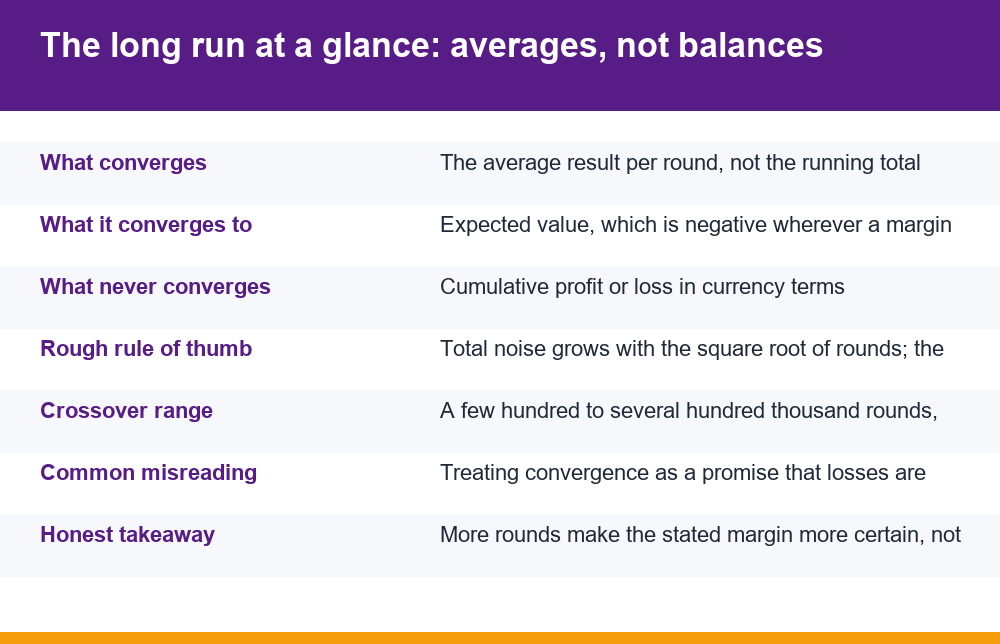
- Convergence is to the expectation, whatever it is. If the expected value per round is negative, the observed average converges on a negative number. There is no mechanism in the theorem that steers results towards break-even. Break-even is not the target; the expectation is.
- Convergence is in the average, not the total. An average that tightens around minus two pence per unit staked, across one hundred thousand units staked, is a total that tightens around minus two thousand pounds. The average becomes more predictable as the total becomes larger.
That second point is the pivot of the whole topic. People hear “converges” and picture a balance returning to zero. What actually tightens is the rate. The more rounds are played, the more confidently the eventual rate can be predicted — and a predictable negative rate applied to a growing stake total produces a growing shortfall, not a shrinking one. The certainty increases; it is just certainty about something unwelcome.
There is also a condition that is quietly important: the rounds must be independent and identically distributed, or close enough to it. Independent means earlier results carry no information about later ones. Identically distributed means the odds and payouts are not changing underneath you. Where either condition breaks — changing stake sizes, changing markets, changing payout structures — the clean convergence statement no longer applies in a simple form, which is one reason mixed betting records are so much harder to read than single-game records.
It is worth being precise about what “converges in probability” means too, because the phrase is weaker than it sounds. It does not say the average will be within some fixed distance of the expectation after some fixed number of rounds. It says that for any tolerance you choose, however tight, the chance of the average sitting outside that tolerance falls towards zero as rounds accumulate. No round count is ever enough to make it a certainty. That is why every figure in the table further down is a crossover point rather than a deadline.
Why it is not the gambler’s fallacy
The gambler’s fallacy is the belief that a result which has not appeared recently has become more likely. Red has landed eight times, therefore black is overdue. The colour has gone one way for six rounds, therefore the other way is building up. It is one of the most robust errors in human reasoning, and it survives partly because people think the law of large numbers in betting endorses it.
It does not, and the reason is structural. Independence means each round is drawn afresh from the same distribution. A sequence of past results changes nothing about the next draw, because there is no memory anywhere in the system to hold the imbalance. Convergence happens not by correction but by dilution: as the denominator grows, any given early imbalance contributes a smaller and smaller share of the average.
A worked illustration makes the difference unmistakable. Suppose a fair even-chance game produces 60 wins out of the first 100 rounds — ten more than expected. For the proportion to return close to 0.5, the ten-round surplus does not need to be cancelled by ten extra losses. It simply needs to become negligible relative to the total. After 10,000 rounds, a ten-round surplus moves the proportion by 0.001. The imbalance was never repaid; it was swamped.
The same arithmetic runs in the other direction, which is the part that costs people money. A deficit of ten rounds after a bad stretch is not scheduled for repayment either. It is simply going to matter less and less to the average, while continuing to sit in the balance exactly where it landed. Dilution changes the weight of an imbalance in a ratio. It does not change the currency figure at all.
So the two ideas point in opposite directions. The fallacy predicts a corrective force that does not exist. The theorem describes a smoothing effect that requires no correction at all. Confusing them turns a neutral mathematical fact into a reason to keep staking after losses, which is exactly how a misread theorem becomes an expensive one.
How many bets is a long run?
“The long run” is used as if it were a fixed number of rounds. It is not. It depends entirely on how large the margin is relative to how wildly individual results scatter, and the relationship is not intuitive.
The arithmetic behind it is short. Across n rounds, the expected shortfall grows in proportion to n — it is simply the per-round expectation multiplied by the number of rounds. The random scatter around that figure, meanwhile, grows in proportion to the square root of n. Linear growth eventually outruns square-root growth, always. Setting the two equal gives the point where the margin becomes as large as one standard deviation of noise, and that happens at roughly (spread ÷ margin)² rounds, where spread is the standard deviation of a single round’s result per unit staked.
Run that formula on a few representative structures and the spread between them is enormous:
| Wager structure (per unit staked) | Margin per round | Spread of one round | Rounds until margin equals one standard deviation | Rounds until margin equals three standard deviations |
|---|---|---|---|---|
| Near-even payout, typical two-way market margin | about 4.5% | about 1.0 | about 500 | about 4,400 |
| Two-outcome colour-style round with a 5% margin | about 5% | about 1.0 | about 400 | about 3,600 |
| Even-chance table bet, single-zero wheel | about 2.7% | about 1.0 | about 1,400 | about 12,300 |
| Single-number table bet paying 35 to 1 | about 2.7% | about 5.8 | about 46,800 | about 421,000 |
The bottom two rows carry the identical margin. The only difference is how spread out individual results are, and that alone moves the crossover point by a factor of more than thirty. This is the practical answer to “how many bets is a long run”: anywhere from a few hundred rounds on a tight, near-even market to several hundred thousand on a long-shot payout. Anyone claiming a universal figure is guessing.
It is worth being clear about what the crossover does not mean. Reaching the one-standard-deviation column does not mean the record turns negative at that point, or that anything changes at that point. Nothing changes; the two quantities simply cross. Before it, a single lucky stretch can easily outweigh the accumulated margin. After it, outweighing the margin requires a stretch that is increasingly extreme relative to the ordinary scatter. The transition is gradual, and the only thing the figure marks is where the margin stops being the smaller of the two forces.
There is a second, harder implication. Even at the three-standard-deviation column, the outcome is not certain — it is merely very unlikely to be positive. The theorem offers convergence, not a deadline. Which is why a record of a few hundred rounds tells you almost nothing about the structure being played, and a record of a few hundred rounds on a high-spread payout tells you nothing at all. Treating a short sample as evidence of anything is the mistake that short-run variance makes so easy to fall into.
Why convergence works against the player
This is the part that academic treatments leave implicit and promotional ones leave out. Convergence is directional. It drags the observed average towards the expectation, and the sign of the expectation decides who benefits from being dragged.
Where a margin is built into the payouts, the per-round expectation is negative for the person placing the bet and positive for the person taking it. Both sides are subject to the same theorem. For one side, more rounds mean a tighter guarantee of a negative rate. For the other, more rounds mean a tighter guarantee of a positive one. Nothing in the mathematics treats the two parties differently — it is the sign of the expectation, fixed in advance by the way the margin is priced into every round, that determines who the long run favours.
The clearest way to see the asymmetry is to ask what a player’s best realistic hope is. It is an early positive swing — noise large enough to overwhelm the margin before the margin has had enough rounds to dominate. That hope lives entirely in the short run, in the region where the theorem has not yet bitten. Every additional round moves away from it. Patience and persistence both increase the number of rounds, and increasing the number of rounds is precisely what strengthens the margin’s grip.
This also disposes of an entire family of claims. No staking pattern, progression, or sequence-reading method changes the per-round expectation, because none of them changes the payouts or the probabilities. Rearranging stake sizes across rounds reshapes the distribution of outcomes — it can make a losing session rarer and more severe, or more frequent and milder — but the expectation of the total is the sum of the expectations of the parts regardless of how they are ordered. There is no arrangement of negative terms that sums to a positive number. The honest reading of the law of large numbers in betting is that no system beats the margin, because the theorem is the reason the margin wins.
The same logic sets a ceiling on what published return figures mean. Return-to-player and overround percentages are long-run averages by construction: they describe the limit the average converges to, not what any individual session will resemble. A figure of that kind is computed over a number of plays far larger than anyone accumulates personally, which is why it is a statement about the structure of the payouts and never a forecast for an evening.
Can a short winning streak contradict it?
No — and the fact that it cannot is worth understanding properly rather than just accepting, because it is the detail that makes the whole topic click.
The theorem makes a claim about behaviour as the number of rounds grows without limit. A streak of twelve wins, or a profitable month, or a profitable year on a low-volume record, is a statement about a finite and usually small sample. Those two statements are not in tension. The theorem actively predicts that short samples will scatter widely, because the scatter only shrinks as the sample grows. Streaks are not exceptions to the rule; they are what the rule looks like before it has had room to operate.
There is also a selection effect worth naming. Across many people playing many sessions, some will be ahead at any moment — that is arithmetic, not evidence. The ones who are ahead are the ones who talk about it, write about it, and get quoted. A sampling of visible results is drawn overwhelmingly from the lucky tail, which makes the short run look far more generous than it is. The underlying distribution has not changed; only the slice on display has.
So what can a streak legitimately tell you? Very little about the structure of the game, and quite a lot about your own reaction to it. The questions worth asking after a good run are behavioural rather than mathematical:
- Did the stake size per round stay where it was before the run started, or did it drift upwards?
- Did the number of rounds per session increase because the run felt like confirmation of something?
- Would the same conclusion have been drawn from a sample this size if the result had gone the other way?
- Is the sample anywhere near the crossover figures in the table above for this particular payout structure?
- Has the record been kept in enough detail to answer the previous four questions honestly?
If the answers to those are uncomfortable, that is information of a different kind, and it matters more than the streak did. Anyone who finds that stakes or session lengths are moving on their own can reach free, confidential help through the free Tele-MANAS mental-health helpline.
Why the house benefits from the law of large numbers in betting
The operator’s position differs from the player’s in one respect that matters more than all the others combined: volume. A single player accumulates rounds slowly, one session at a time, across weeks. The book accumulates rounds from every player simultaneously, continuously, across every market it offers.
That difference is decisive because, as the arithmetic above showed, the crossover between margin and noise is governed by round count. A book handling a very large number of rounds per day sits far past the crossover almost immediately. Its realised average per round is pinned close to the designed margin. Its revenue over a period becomes a predictable function of total turnover rather than a gamble on outcomes.
The individual player sits on the other side of the same curve, and this is the real force of the law of large numbers in betting from an operator’s point of view. One person never reaches the volume at which their own results become predictable, which is exactly why individual sessions feel like genuine contests. But the operator does not need any individual session to go its way. It needs the aggregate, and the aggregate is where the theorem is binding.
A compact comparison of the two positions:
- Round count. The player accumulates rounds in the hundreds or low thousands. The aggregate book accumulates them continuously across all players and markets.
- Sign of expectation. Negative for the player wherever a margin exists, positive for the book, by construction rather than by chance.
- Exposure to noise. Dominant for the player, where a single result can swamp the margin. Negligible for the book, where results average out across a very large number of simultaneous positions.
- What the long run delivers. For the player, increasing certainty of a negative rate. For the book, increasing certainty of a positive one. Same theorem, opposite sign.
It also explains why books care about turnover rather than about individual winners. A high-volume operation is not threatened by paying out a large win; it is threatened only if the margin is mispriced, or if its positions are concentrated rather than spread. The theorem converts a correctly priced, widely spread margin into predictable income, which is why pricing and exposure management are where the real work happens and why no amount of result-reading on the player’s side touches either.
Record-keeping checklist for anyone testing this themselves
The one genuinely useful thing an individual can do with this theorem is use it to read their own record honestly. That requires a record that is capable of being read, which most are not. The usual failure is a mental running total, which is both the least reliable figure and the one the theorem says least about.
What to capture, and why each item matters:
- Round count, not session count. The crossover arithmetic is in rounds. A record organised by evening or by month cannot be compared against it.
- Total staked, separately from net result. The average that converges is net result divided by total staked. Without the denominator, the figure that converges cannot be computed at all.
- Payout structure per round. Mixing a near-even market with a long-shot payout in one record blends two wildly different spreads and makes the combined average far harder to interpret.
- Stake size per round. Varying stakes break the identically-distributed condition. If stake size drifted, the record measures the drift as much as the game.
- Every round, including the unrecorded ones. Omitting small or embarrassing rounds is the fastest way to manufacture a flattering average, and it is almost always unconscious.
- Date and elapsed time. Useful less for the mathematics than for noticing whether round volume is quietly increasing.
Two things that record will not do. It will not identify a profitable approach, because the per-round expectation is set by the payouts and no record changes those. And it will not reach a verdict quickly: compare your round count against the table above and the honest conclusion for most personal records is that the sample is too small to say anything. That is a real result, not a failure of the record.
What it will do is replace a feeling with a number. A running average per unit staked, tracked over a growing round count, is the only quantity the theorem actually speaks about — and watching it settle, slowly, towards the structural margin is the most direct demonstration of the law of large numbers in betting that anyone is likely to encounter. Most people find the exercise clarifying rather than encouraging, which is rather the point.
If there is a single sentence to carry away from all of this, it is that more rounds buy certainty rather than recovery. The theorem is generous with information and entirely ungenerous with money. It tells you, with increasing confidence the longer you look, exactly what rate you are paying — and the one thing it never does is hand any of it back.
Frequently Asked Questions
What does the law of large numbers mean in betting?
It means that as the number of rounds grows, the observed average result per round converges on that round’s expected value. It is a statement about the average, not about the cumulative balance. Where a margin is built into the payouts, the expected value per round is negative, so the average converges on a negative number rather than on break-even.
Does the law of large numbers mean losses even out?
No. Nothing in the theorem pushes a balance back towards zero. Convergence happens by dilution, not correction: an early imbalance is not repaid, it simply becomes a smaller share of a growing denominator. An average that settles at a negative rate, applied across a growing total staked, produces a growing shortfall rather than a shrinking one.
How many bets is a long run?
There is no universal figure. It depends on the margin relative to how widely individual results scatter, roughly as (spread ÷ margin) squared. On a near-even market with a typical margin that crossover is in the region of a few hundred rounds; on a long-shot payout such as a 35-to-1 single-number bet, carrying the same margin, it runs into the tens of thousands. Anyone quoting one fixed number is guessing.
Is the law of large numbers the same as the gamblers fallacy?
No, they point in opposite directions. The fallacy claims an outcome becomes more likely because it has not appeared recently, which independence rules out — there is no memory in the system to hold an imbalance. The theorem describes a smoothing effect that needs no corrective force at all: the imbalance is swamped by later rounds rather than cancelled by them.
Why does the house benefit from the law of large numbers?
Because both sides are subject to the same theorem but with opposite signs, and the operator reaches the volume where it bites almost immediately. Aggregated across all players and markets, a book’s realised average per round is pinned close to its designed margin, turning revenue into a predictable function of turnover. An individual never accumulates enough rounds for their own results to become predictable in the same way.
Can a short winning streak contradict it?
No. The theorem is a claim about behaviour as round count grows without limit, and it actively predicts that small samples will scatter widely. A streak is what the rule looks like before it has had room to operate. Visible winning runs are also selected for — the people currently ahead are the ones who talk about it — which makes the short run appear far more generous than the underlying distribution is.