This article looks at colour-prediction odds the way an analyst would: by working out what each bet is worth on average, rather than how a lucky round feels. Using illustrative numbers, it covers expected value, house edge, trend charts and the cost of fast rounds. It is an explainer, not an invitation to play. Real money is at risk, outcomes are down to chance, and this content is for adults aged 18 and over only.
Table of Contents
Why Analysts Should Study Colour Games
Cricket-betting readers already think in probabilities, implied odds and margins. Colour-prediction apps look nothing like a cricket market, but the same tools apply, and more cleanly. A colour round has no form guide, no pitch report and no team news. It is a pure random draw with a payout table attached.
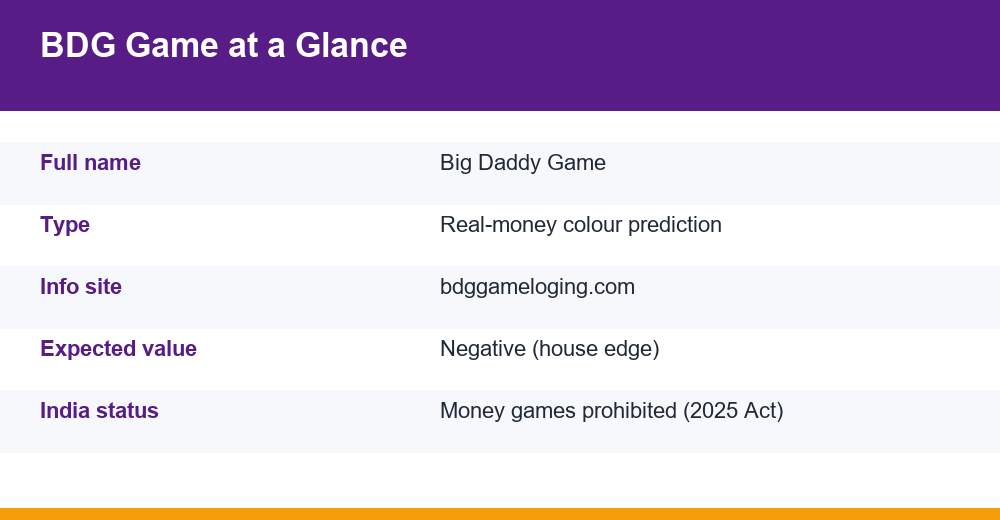
One example is BDG Game, short for Big Daddy Game, a real-money colour-prediction and multi-game app aimed at players in India. If you want a neutral overview of how the app is described and organised, the BDG Game guide covers the basics; this article sticks to the maths, which is the same for any game of this type. Figures below are rounded, and examples use ₹100 stakes to keep the arithmetic simple.
How the Odds Work in a Single Round
To talk about odds sensibly, we need a model of one round. The layout below is a common colour-game structure used purely for illustration. It is not a statement of any particular app’s rules or payouts, which can differ and can change, so always read the rules page if you want exact figures.
In this model, each round draws one number from 0 to 9, each equally likely. Numbers 1, 3, 7 and 9 are green; 2, 4, 6 and 8 are red; 0 and 5 are split colours that also carry violet.
| Illustrative bet | Winning numbers | Chance per round | Illustrative payout |
|---|---|---|---|
| Green | 1, 3, 7, 9 (full); 5 (split) | 40% full, 10% split | 2x full, 1.5x split |
| Red | 2, 4, 6, 8 (full); 0 (split) | 40% full, 10% split | 2x full, 1.5x split |
| Violet | 0, 5 | 20% | 4.5x |
| Single number | Any one of 0-9 | 10% | 9x |
Every payout is set slightly below what a fair game would pay. A fair single-number bet at 10% would pay 10x; the table pays 9x. That gap between true probability and offered payout is where the operator’s margin lives, much like the overround in a sportsbook. A colour game simply hides that margin inside its multipliers rather than its decimal odds.
Lesson 1: Expected Value Per Bet
Expected value (EV) is the average result of a bet if you could repeat it endlessly. You multiply each possible return by its probability, add them up, then subtract the stake. Take an illustrative ₹100 bet on green:
- 40% chance of a full win returning ₹200: contributes ₹80
- 10% chance of a split win returning ₹150: contributes ₹15
- 50% chance of losing: contributes ₹0
- Average return: ₹95, so EV = ₹95 minus ₹100 = minus ₹5
A single number (10% × ₹900) and violet (20% × ₹450) both return ₹90 on average, an EV of minus ₹10. No choice of colour, number or size turns the average result positive. Bet selection only changes how bumpy the ride is, not where it ends.
Lesson 2: House Edge as a Percentage
House edge is negative EV expressed as a share of the stake. In our model, green and red carry a 5% edge, while violet and single numbers carry 10%. Some colour apps also take a service fee from each stake before the bet is placed. With an illustrative 2% fee, your ₹100 becomes a ₹98 bet, which is then subject to the edge.
| Illustrative scenario | Average return per ₹100 | House edge |
|---|---|---|
| Green/red, no fee | ₹95.00 | 5.0% |
| Green/red, 2% fee | ₹93.10 | 6.9% |
| Single number, no fee | ₹90.00 | 10.0% |
| Single number, 2% fee | ₹88.20 | 11.8% |
A small-looking deduction at the start of each bet quietly raises the real cost of every round. The same check applies to promotions. Bonuses and cashback usually come with wagering requirements, and every one of those wagers carries the same edge, so a bonus often creates more turnover for the operator rather than real value for the player.
Lesson 3: Streaks and Trend Charts Are Noise
Colour apps often show recent results as a trend chart. But if each round is an independent draw, that history says nothing about the next result. Independence means the draw has no memory: after five reds in a row, the chance of green is exactly what it always was. Believing green is now “due” is the classic gambler’s fallacy.
Streaks are also far more common than intuition suggests. The chance of any five particular rounds all missing green is 0.5 to the power 5, roughly 3.1%, so over a hundred rounds a run of five or more is very likely to appear somewhere.
- Patterns spotted after the fact (“red, red, green repeats”) are fitted to noise.
- Martingale-style doubling after losses does not change EV; it just puts more money in front of the same negative edge.
- Paid “prediction” groups or signal sellers cannot know an independent outcome in advance.
Lesson 4: Turnover Multiplies Expected Loss
A 5% edge sounds modest. The trap is that it applies to turnover, the total amount staked, not to your starting balance. Fast rounds recycle the same money, and the edge is charged every time. Here is an illustrative hour of ₹100 bets on green:
| Round length | Rounds per hour | Turnover per hour | Expected loss per hour |
|---|---|---|---|
| 3 minutes | 20 | ₹2,000 | ₹100 |
| 1 minute | 60 | ₹6,000 | ₹300 |
| 30 seconds | 120 | ₹12,000 | ₹600 |
Expected loss equals stake × rounds × house edge, so doubling the speed doubles the cost even though each bet looks identical. Over a two-hour evening at one-minute rounds, the illustrative expected loss reaches ₹600, from a habit that only ever looked like ₹100 at a time. If you want a framework for setting hard limits on time and spend, our piece on session discipline for analysts walks through practical rules.
Lesson 5: Short-Run Luck Hides the Edge
If every bet loses money on average, why do some people report winning sessions? Because of variance. Over a handful of rounds, random swings are far larger than the small average cost per bet. Over thousands of rounds the picture reverses: swings grow roughly with the square root of the number of bets, while expected loss grows in a straight line.
Over 10 bets of ₹100 on green, the expected loss is only ₹50, while a typical swing is around ₹300 either way. Over 10,000 bets, the expected loss reaches ₹50,000 against a typical swing of about ₹10,000. At that volume, a net loss is close to certain, whatever the screenshots of big wins suggest.
A practical test: before any session, write down the stake, the rounds you expect to play and the edge, then multiply them. If 120 bets of ₹100 at 5% gives ₹600, ask whether you would pay that sum upfront for the same evening. If not, the session costs too much.
Legal Position in India and Safety Checks
The maths is only part of the story for readers in India. Under the Promotion and Regulation of Online Gaming Act, 2025, offering online money games, advertising them and facilitating payments for them are prohibited, with criminal penalties for those involved. Rules notified later by the Ministry of Electronics and Information Technology set up the Online Gaming Authority of India as regulator. Real-money colour-prediction games appear to fall within the Act’s broad definition of online money games, whatever an app calls them. This is a general summary, not legal advice.
We have no evidence to call this particular app a scam, and we do not. But any real-money platform in this space deserves caution. Watch for these red flags:
- Withdrawals that stall, need extra deposits, or demand “tax” or “unlock” fees first
- Payments routed to personal UPI IDs or changing accounts
- Promises of guaranteed profit, signals or “winning tricks”
- APK downloads from unverified links rather than official app stores
If you already hold a balance on any colour app, our colour-prediction withdrawal check explains what to verify before assuming money can be taken out. If you suspect fraud, report it at cybercrime.gov.in or call the 24-hour helpline 1930. If gambling is affecting your mood, sleep or finances, Tele-MANAS offers free mental-health support on 14416.
The bottom line is simple. Every bet in these games carries negative expected value, fast rounds multiply that cost, and streaks are noise rather than signal. Add the 2025 law in India, and the maths offers a player little beyond a clear view of the real cost.
Frequently Asked Questions
Can maths help me win at colour-prediction games?
No. Maths shows the opposite. In illustrative models of colour-prediction rounds, every bet has negative expected value because payouts sit below true probabilities. Analysis can help you understand the cost of playing, but no strategy, pattern or staking plan turns a negative edge into a positive one.
Do trend charts in colour games predict the next result?
No. If each round is an independent random draw, past results carry no information about the next one. Streaks appear naturally in random sequences, and expecting a colour to be due is the gambler’s fallacy.
Are real-money colour-prediction apps legal in India?
The Promotion and Regulation of Online Gaming Act, 2025 prohibits offering, promoting and facilitating payments for online money games in India, which covers real-money colour-prediction apps. This is a general summary, not legal advice; consult a qualified lawyer about your specific situation.
Where can I get help with gambling fraud or stress?
Report suspected online fraud at cybercrime.gov.in or by calling the national helpline 1930. For mental-health support related to gambling, stress or anxiety, Tele-MANAS provides a free helpline on 14416. Talking to a trusted person early also helps.