Betting identity verification is the document-checking step a platform runs to confirm that the person holding an account is the same person who will receive the money out of it, and in practice it is the step most people only discover when a withdrawal stops moving. Search the phrase and you mostly find operator help pages written to reassure, each describing its own form fields and nothing else.
What is missing is the neutral version: the mechanics shared by almost every platform, the reason checks cluster at payout time rather than signup, and the small data mismatches that quietly account for most stuck balances. This breakdown sticks to process. It names no platform, recommends none, and offers no view on whether any of this is a good idea — only on how the check works and how people get tripped by it. 18+ only. Real-money play carries risk, and losses are the expected outcome over time.
Table of Contents
Betting identity verification: the short answer
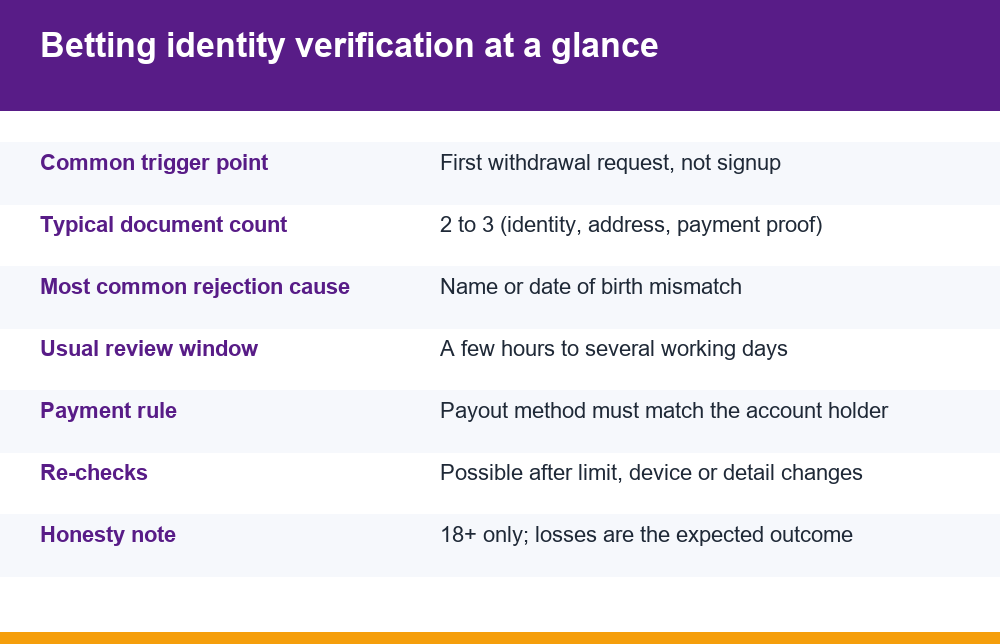
Betting identity verification is a matching exercise, not a character assessment. A platform holds a set of details you typed in — full name, date of birth, address, phone number, payment instrument — and it asks you to supply documents that independently confirm those same details. If the two sets agree, the account is marked verified. If they disagree in any field the reviewer treats as material, the check fails and the account sits in limbo until you resolve the gap.
That single idea explains almost every frustration people report. The check is not usually failing because something is wrong with you; it is failing because two records do not agree. A middle name present on the document and absent from the profile. A date of birth entered with the month and day transposed. An address updated in real life two years ago but never updated on the account. A card belonging to a family member. None of these are exotic problems, and all of them produce the same outcome: a review that cannot be completed.
It helps to picture the process as three separate questions rather than one. Are you a real, identifiable adult? Do you live where you say you live? Does the money route in and out of an instrument that belongs to you? Each question is answered by its own document, each can pass or fail independently, and a single failure holds the whole account. People often assume a rejection means the platform doubts their identity outright, when in reality two of the three questions may have passed cleanly and only the third needs attention.
The second thing worth knowing up front is the timing. Most platforms let you deposit and play with minimal checks and only demand full documentation when money tries to leave. That sequencing is deliberate and it is the source of the classic complaint — “I played for months and only now they want papers.” Understanding why it happens that way is most of the battle, and it is the subject of a later section.
Everything that follows expands those points: what gets asked for, why, what breaks, and what you can do before you ever deposit to make the check uneventful.
Why do betting sites ask for identity documents?
There are four practical reasons a platform wants documents, and they have nothing to do with suspicion of you specifically.
Account ownership. An online account is just a username and a password. Both can be shared, sold, guessed or stolen. Before releasing funds, the operator wants evidence that the human requesting the payout is the human the account belongs to. A document with a photograph and a matching name is the cheapest available proof of that.
Age. Real-money play is for adults only, and a self-declared birth date in a signup form proves nothing. A document showing date of birth converts a claim into a check. This is the one part of the process nobody seriously objects to.
Payment fraud. Chargebacks and disputed deposits frequently involve a payment instrument used by someone other than its owner. Confirming that the card, wallet or bank account bears the same name as the profile closes that loop. It also protects the account holder: if your details are the ones on file, a stranger who gains access cannot simply redirect your balance to their own account.
Duplicate accounts. Platforms want one account per person, partly for their own exposure management and partly because promotional mechanics are trivially abusable with twenty accounts. Document checks are how duplicates get spotted — the same identity surfacing under three usernames is visible once documents enter the picture.
Notice what is not on that list: none of these reasons require the platform to trust you less than it trusts anyone else. Betting identity verification is applied in bulk, by process, usually with substantial automation doing the first pass. Treating it as a personal accusation leads people to respond badly — sending partial documents, arguing instead of correcting, opening a second account — and every one of those responses makes the delay longer.
It is also worth separating the platform’s motive from your interest, because they overlap only partly. The operator wants to avoid paying the wrong person. You want to be able to collect what is in the balance. Those two aims point in the same direction right up to the moment your records disagree, at which point the operator’s default is to stop and yours is to hurry. Recognising that asymmetry is what stops people from escalating a clerical problem into a dispute.
The flip side is that a verification request is also a moment to be careful. The same request pattern is imitated by fraudulent setups and by phishing messages that arrive out of the blue, and that is covered near the end of this breakdown.
What documents are usually requested for verification?
Requests vary in wording but almost always fall into three buckets: who you are, where you live, and how money reaches you. Most accounts need something from the first bucket and at least one of the other two, and a minority are asked for a liveness check on top.
The table below sets out what each bucket is for, what typically satisfies it, and the failure that recurs most often in each row.
| Bucket | What it proves | Typical items accepted | Common failure |
|---|---|---|---|
| Identity | Full name, date of birth, photograph | Government photo identity document; passport | Expired document, or name order differs from profile |
| Address | Current residential address | Recent utility bill, bank statement, official correspondence | Document older than the stated window, or an old address |
| Payment | The instrument belongs to you | Card image with middle digits hidden, wallet or bank statement header | Account in a relative’s name, or a screenshot missing the name |
| Liveness | A real person is present now | Selfie, or short video holding the document | Blur, glare, cropped edges, heavy filters |
| Source context | Unusual activity has an explanation | Occasionally requested at higher balances | Ignoring the request rather than answering it |
Two details about documents are worth internalising because they cause disproportionate trouble. First, the image matters as much as the document. A perfectly valid identity document photographed at an angle, with flash glare across the name line or with one corner outside the frame, will be rejected on image quality alone and the rejection notice often does not say which problem it was. Shoot flat, in daylight, on a plain surface, with all four corners visible and no fingers covering text.
Second, address documents have a freshness window. Platforms commonly want something dated within the last few months. A bill from eighteen months ago is not accepted even though your address has not changed, because the point is to show the address is current, not that it once existed. If nothing recent arrives in your name on paper, a downloaded statement from a bank or utility account is usually the easiest substitute, provided the name and address header is visible and uncropped.
A practical ordering helps here. Decide which identity document you will use first, then make the profile and every other document agree with it, rather than collecting documents and hoping they converge. The identity document is the hardest thing to change and the easiest thing to build the rest around.
- Photograph documents flat, in natural light, with all four corners inside the frame.
- Submit the full page or full card face — not a crop showing only the name.
- Check the expiry date before uploading; expired documents are an automatic fail.
- Use an address document dated within the window the platform states.
- Never edit, retouch or annotate an image; any alteration reads as tampering.
- Photograph the document itself, never a screen displaying it.
- Send the formats requested — a PDF where an image was asked for sometimes fails silently.
Why verification is triggered when you try to withdraw
This is the part that feels unfair, and it has a mundane explanation. Signup friction costs platforms registrations. Every extra field, every document upload, every delay between arriving and placing a first bet reduces the number of people who finish the process. So the commercial incentive is to make the front door as light as possible: an email, a phone number, a password, a deposit, go.
Money leaving the platform carries the opposite incentive. A payout is irreversible in practice, so it is the point where confirming identity has the most value to the operator. The result is a predictable asymmetry — almost no checking on the way in, full checking on the way out. Most people meet betting identity verification for the first time at exactly the moment they least want a delay.
There is a second, less obvious trigger: change. Even a fully verified account can be sent back for re-checks when something material moves. Adding a new payment method, requesting a withdrawal to a different destination than the one you deposited from, a large jump in stake or balance size, logging in from an unfamiliar device or a different region — any of these can reopen a check that was previously closed. That is why a second withdrawal sometimes needs paperwork when the first one did not, and why people conclude the rules changed when in fact a trigger fired.
The practical conclusion is unglamorous but effective: get verified before you need the money, not when you need it. Many platforms let you submit documents voluntarily soon after registration. Doing it on a quiet afternoon, with time to re-shoot a bad photo and correct a profile field, is a completely different experience from doing it under the pressure of a pending balance. If you want the wider sequence of what happens between requesting funds and receiving them, the stage-by-stage look at the timeline a withdrawal request moves through covers where this check sits in the chain.
How long does document review usually take?
Honestly: it varies, and anyone quoting a single universal figure for betting identity verification is guessing. What can be described reliably is the shape of the wait rather than its length.
Straightforward cases — clean images, every field matching, standard document types — are frequently handled by automated matching within hours, sometimes minutes. Cases that fall out of automation and land in a manual queue take longer, typically measured in working days rather than hours. Cases requiring a second round of documents reset the clock, because the review restarts when new files arrive rather than continuing from where it stopped.
Several factors stretch the wait, and most of them are visible in advance:
- Weekends and public holidays. Manual review queues are staffed on working days; a Friday-evening submission often means a Monday or Tuesday answer.
- Second and third rounds. Each resubmission re-enters the queue rather than jumping it.
- Unusual document types. Anything outside the common set may need a specialist reviewer.
- Partial submissions. Sending one of three requested items means the file waits until the rest arrive.
- Volume periods. Queues lengthen around major sporting events, when registrations and withdrawals both spike.
One behaviour makes things materially worse: chasing. Opening a fresh support ticket every few hours, or submitting the same document repeatedly through different channels, frequently pushes a case backwards because the file is touched and re-sorted each time. Submit once, completely, then wait the stated window before following up. If you must follow up, reply in the existing thread rather than starting a new one, and quote the reference number the platform gave you.
The other thing that helps is reading the request precisely. Requests are often templated and list several acceptable options per bucket; people skim, pick the hardest option, and then wait days for a document they did not need to send. Read the list, choose the item you can photograph cleanly today, and send that.
It is also worth noting what the wait does not mean. A long review is not evidence that something has been found. Manual queues are shared across every account that fell out of automation for any reason, including trivially clean cases with an unusual document type. Reading a delay as a verdict is how people talk themselves into opening a second account, which is the one action that converts a wait into a refusal.
What causes a verification to be rejected
Rejections cluster into a surprisingly short list, and the great majority are data mismatches rather than genuine problems. Ranked roughly by how often they appear in people’s accounts of stuck payouts:
- Name mismatch. A middle name on the document but not the profile, initials instead of full names, a married name on one record and a maiden name on the other, or the given name and surname entered in the opposite order.
- Date of birth mismatch. Almost always a typo at signup, or a day/month transposition from a differently formatted date field.
- Stale address. The profile holds an address you moved away from, or the document pre-dates the acceptable window.
- Payment instrument in another name. A shared family card, a partner’s wallet, a friend’s bank account.
- Image quality. Glare, blur, cropped corners, low resolution, or a screen photographed instead of the document itself.
- Expired document. Valid yesterday, expired today, rejected either way.
- Duplicate identity. The same person already verified on another account with the platform.
- Edited files. Any retouching, redaction beyond what was asked for, or metadata suggesting alteration.
The uncomfortable detail is that rejection notices are usually vague. They tell you the check failed and invite you to try again, without specifying which field disagreed. That vagueness is partly deliberate — a precise error message is a roadmap for anyone attempting to defeat the check — and partly just template laziness. Either way, you are left diagnosing it yourself.
The sensible diagnostic order is: compare your profile fields character by character against the document, fix the profile rather than the document, re-shoot the image even if you think it was fine, and only then contact support with a specific question. “My profile shows my name without my middle name; should I update the profile or send a different document?” gets a useful answer. “Why was I rejected?” gets the template back.
Where correcting a profile is itself restricted, say so plainly in the thread and ask for the field to be amended on their side. Many platforms lock name and date-of-birth fields after first use precisely so they cannot be edited to match whichever document is convenient — which means the only route is a support correction, and that correction is usually possible once you ask for it directly.
One more pattern deserves naming, because it is self-inflicted and common: fixing the wrong side of the mismatch. Faced with a profile that reads differently from the document, people hunt for another document that matches the profile instead of correcting the profile. That works once, then fails at the next check, because the account is still carrying details that no document of yours supports. Make the profile true, and every future check gets easier.
Why the payment method must be in your own name
This rule generates more arguments than any other part of betting identity verification, usually because the person affected genuinely does have permission to use the card or account in question. The permission is not the point.
The rule exists because a payout is a transfer of value to a named destination. If the account holder is one person and the payment destination is another, the platform cannot demonstrate that the money went to the person entitled to it. Every downstream problem — a disputed deposit, a stranger draining an account, a family member saying they never agreed to anything — is cheaper to prevent than to unwind. So the match is enforced mechanically: same name on the profile, the document and the payment instrument.
Two consequences follow that are worth planning around. First, the deposit method and the withdrawal method are usually expected to be the same instrument. Depositing from one wallet and asking for a payout to a different one is a standard trigger for additional checks, even on a verified account. Second, a joint account is not automatically acceptable, because a joint account’s documentation may not clearly establish which holder received the funds.
If the only payment instrument available to you is in somebody else’s name, the honest answer is that the account should not be funded that way in the first place. The usual outcome is not a lecture — it is a balance that cannot be paid out, because there is no matching destination for it. Sorting the payment side out before depositing is far easier than arguing about it afterwards, and it is the single highest-value thing on this page.
The name-match rule also means consistency across any accounts you hold matters more than people expect. If you have ever set up a registration for smaller tournament markets, the details you entered there are worth comparing against your main profile before you need either of them verified.
Mistakes to avoid: the pre-signup detail checklist
Almost everything described above can be avoided at the signup screen, in about four minutes of care. The mistakes below are the ones that compound quietly for months before surfacing.
- Typing a shortened name. Enter your full name exactly as it appears on the identity document you intend to use — every given name, in the same order, with the same spelling.
- Guessing at the date format. Check whether the field wants day-month-year or month-day-year before typing, then re-read it after.
- Using an old address. Enter the address that appears on a document you can actually produce now, not the one you think of as home.
- Registering with a phone number or email you do not control long term. Recovery and verification messages go there.
- Depositing before checking the payment name. Confirm the instrument is in your own name first.
- Opening a second account because the first is stuck. This converts a delay into a duplicate-identity rejection on both.
- Never reading the account’s own verification page. Most platforms publish the document list; checking it before you need it costs nothing.
One structural mistake deserves its own mention: treating multiple products on one platform as separate worlds. Where a single profile spans several sections of a site, the check attaches to the identity rather than to the product, so a mismatch anywhere affects everything. Anyone whose profile covers both sportsbook and casino sections should read how a single profile covering both casino and cricket sections behaves before assuming a check cleared in one place carries over automatically.
None of this changes the underlying arithmetic of real-money play, and it is not meant to. A verified account loses money at exactly the same expected rate as an unverified one. The only thing verification changes is whether you can collect on the rare occasions when variance goes your way. Getting it right is administrative hygiene, not strategy, and nothing in this process alters the margin.
Keeping copies of your documents safe
The verification request pattern — “send a photo of your identity document and a bank statement” — is also among the most imitated messages in online fraud, because it asks for exactly the package a criminal needs. Knowing this is the point of this section; it is written to warn, not to reassure.
Three habits reduce the risk substantially. Initiate the upload yourself. Go to the account area by typing the address you already use, rather than following a link from an email, SMS or chat message. Unprompted requests arriving by message are the classic vector, and they are convincing because the real process looks identical. Upload only inside the account. A genuine check happens in a logged-in upload form; it does not happen over a messaging app, and a request to send documents to a personal number or an individual’s inbox is a bad sign regardless of how official the surrounding wording sounds.
Send the minimum requested. If a card image is asked for, cover the middle digits and the security code. If a statement is asked for only to confirm the name and address header, there is no reason to leave every transaction line visible.
Keep a note of what you sent, to whom and when — a dated line in a notes file is enough. If documents are later misused, that record is the first thing anyone helping you will ask for. In India, misuse of identity documents and suspected financial fraud can be reported through the national cybercrime reporting portal, and reporting early matters more than reporting completely.
Be equally careful about where copies live afterwards. A folder of document photographs sitting in a phone gallery that syncs to a shared cloud account, or forwarded once over a messaging app and then forgotten, is a standing exposure long after the check itself closed. Delete the working copies once an account is verified, and keep whatever you must keep somewhere that needs a passcode to open.
Finally, be sceptical of any setup that asks for documents but shows no sign of a real verification process — no account upload area, no stated document list, no written timeline. A platform that will take a photograph of your passport over chat has told you something useful about how it handles everything else, and the sensible response is to stop before any money or any document changes hands.
Frequently Asked Questions
Why do betting sites ask for identity documents?
For four practical reasons: to confirm the person requesting a payout owns the account, to check age rather than take a typed birth date on trust, to confirm the payment instrument belongs to the account holder, and to detect duplicate accounts held by the same person. The check is applied in bulk by process, not because of suspicion about a particular account.
What documents are usually requested for verification?
Typically one item proving identity (a government photo document showing your full name and date of birth), one proving your current address (a recent utility bill, bank statement or official letter dated within the platform’s stated window), and often one proving the payment instrument is yours (a card image with middle digits hidden, or a statement header). Some checks add a selfie or short video for liveness.
Why is verification triggered when I try to withdraw?
Because signup friction costs registrations, platforms keep the front door light and concentrate checking at the point where money leaves, which is effectively irreversible. Change also triggers checks: a new payment method, a withdrawal to a different destination, a large jump in balance, or an unfamiliar device can reopen a check that had already closed.
How long does document review usually take?
Clean submissions that pass automated matching often clear within hours. Cases that fall into a manual queue usually take working days, and each resubmission restarts the queue position rather than continuing from where it stopped. Weekends, holidays, partial submissions and busy periods around major events all lengthen the wait.
What causes a verification to be rejected?
Mostly data mismatches rather than real problems. The common causes are a name mismatch (middle names, initials, reversed name order, a maiden versus married name), a date-of-birth typo, an address that is out of date or a document outside the freshness window, a payment method in someone else’s name, poor image quality, an expired document, a duplicate identity, or an edited file.
Why must the payment method be in my own name?
A payout sends value to a named destination, so if the account holder and the payment destination are different people the platform cannot show the money reached the person entitled to it. Permission from the card’s owner does not satisfy that, because the documentation still cannot establish it. The deposit and withdrawal instrument are also usually expected to be the same, and joint accounts are not automatically accepted.