Random number generator games produce each result from a number sequence generated in software, and that sequence carries no memory of what came before — which is the single most important fact about them. Everything else you read about patterns, hot streaks, due numbers and timing windows sits downstream of that one property, and most of it collapses once you take it seriously.
This piece is descriptive rather than persuasive: it sets out how the numbers are produced, what independence between rounds really means, why history cannot be read forwards, and what an independent test report does and does not certify. It also says plainly where the arithmetic leaves a player, because that part usually gets left out. 18+ only. Real-money play carries risk, and a loss is the expected outcome over enough rounds.
Table of Contents
Random number generator games explained in plain terms
A random number generator, usually shortened to RNG, is a piece of software whose only job is to emit values that cannot be meaningfully distinguished from chance by any practical test. In random number generator games, everything you actually see — a wheel slowing down, a colour panel resolving, a card turning over, a dice face settling, a reel clicking into place — is a presentation layer drawn on top of a number that was already chosen before the animation began. The movement exists for the player’s benefit, not for the mathematics.
That separation between the number and the picture is worth sitting with, because almost every misconception starts by confusing the two. The animation has rhythm, momentum and apparent near-misses. The number has none of those things. When a wheel appears to slow as it approaches a particular segment, nothing is being decided in that moment; the segment was fixed and the deceleration curve is a fixed piece of art being played back. A near miss is drawn, not earned.
The second half of the system is the mapping: the rule that turns a raw number into something a player can bet on. If a game offers two colours, the number range is split into two blocks. If it offers ten digits, the range is split into ten. The mapping is what sets the probability of each visible outcome, and it is deliberately fixed rather than drifting round to round. Change the mapping and you change the odds; leave it alone and the odds are the same on round one and round one million.
So three separate things are often lumped together under one word, and keeping them apart makes the rest of this far easier to follow:
- The generator — the software producing the underlying number sequence.
- The mapping — the fixed rule that converts each number into a visible outcome such as a colour, digit or card.
- The paytable — the fixed rule that converts a winning outcome into an amount paid, and this is where the operator’s margin lives.
- The animation — cosmetic playback that communicates the already-decided result to the player.
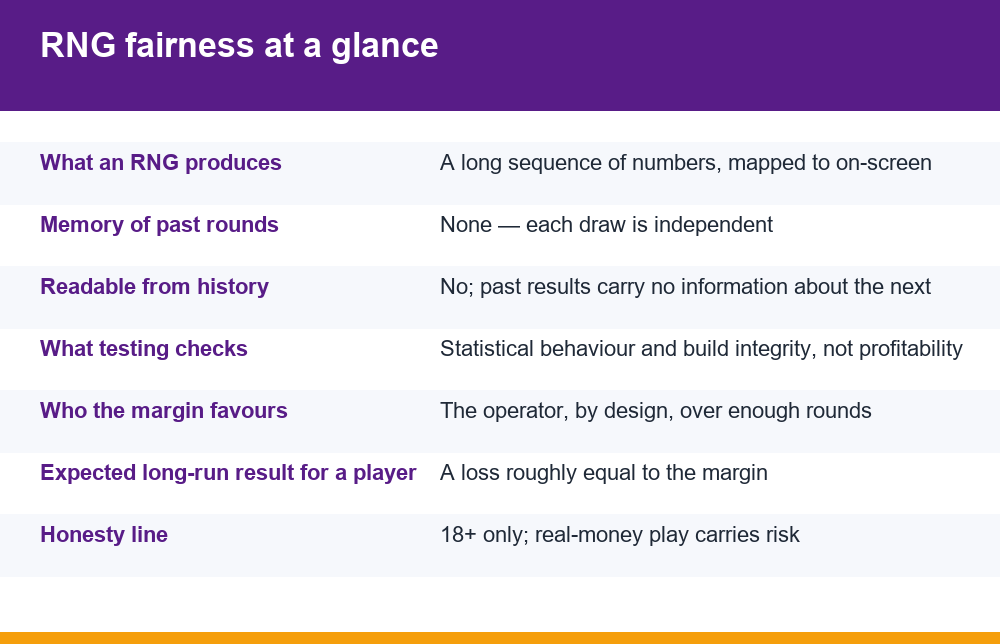
Only the first of those is random. The other three are deterministic business decisions, published or at least discoverable, and they are what actually determine whether a player is up or down over time. It follows that the question people most often ask — is the generator honest? — is not the question that decides their outcome. A completely honest generator sitting behind a paytable that pays less than true odds produces a reliable loss, and it does so without any dishonesty anywhere in the chain.
How a random number generator decides game results
Most production systems use what is properly called a pseudo-random number generator. It starts from a seed — an initial value — and applies a deterministic mathematical function repeatedly, producing a very long sequence of outputs that passes statistical tests for randomness. Cryptographically strong variants draw entropy from hardware sources such as timing jitter or thermal noise, and reseed frequently, so that the sequence cannot be reconstructed even by someone who knows the algorithm.
“Pseudo” sounds like a weakness, and in casual conversation it gets treated as one. In practice a well-built generator is indistinguishable from true randomness for any purpose a player could act on. The sequence is astronomically long, the internal state is large, and the output is deliberately decoupled from that state. Knowing a thousand previous outputs tells you nothing usable about the next one. That is the whole design goal.
The order of operations in a typical round looks like this, and the sequence matters more than people expect:
- The round closes and no further stakes are accepted.
- The generator is queried and returns a raw value from its sequence.
- The fixed mapping converts that raw value into a visible outcome.
- The outcome is written to the round record before anything is shown on screen.
- The animation plays, revealing a result that was already settled.
- The paytable is applied and balances are adjusted.
Step four is the one worth remembering. By the time a player is watching anything move, the result exists. This is why watching an animation closely, slowing a video down, or trying to intervene mid-spin cannot affect anything — there is nothing left to affect. It also means that the feeling of a result being “so close” is an artefact of the reveal, not evidence that the outcome was nearly different.
Some implementations go further and commit to the result in a way a player can check afterwards, by publishing a value derived from the outcome before the round and the inputs after it. Where that exists it addresses one narrow worry — whether the result was chosen after bets were visible — and it leaves everything else untouched. It is a transparency mechanism rather than a change to the odds, and it is worth describing accurately instead of treating it as a seal of general trustworthiness.
A reasonable follow-up is whether the generator could be queried repeatedly until a convenient number appears. That would be a straightforward integrity failure rather than a property of randomness, and it is one of the specific behaviours that independent testing is designed to look for. The point is that it would be a fault in the plumbing around the generator, not in the generator itself — which is why the testing section below separates the two.
Are RNG game rounds really independent?
Yes, and independence has a precise meaning that is narrower than most people assume. Two events are independent when knowing the outcome of one does not change the probability of the other. In random number generator games that are correctly implemented, the result of round 500 does not alter the probability distribution of round 501 by any amount at all. There is no carry-over, no accumulating pressure and no bookkeeping of what is owed.
The reason this feels wrong is that the human brain is very good at pattern detection and very bad at accepting that a pattern can be meaningless. A run of eight identical colours looks like information. It is not. A fair two-outcome draw produces runs of eight about as often as the arithmetic says it should, which over thousands of rounds is often enough to be unremarkable. The run is a normal feature of randomness, not a deviation from it.
It is worth being concrete about how unremarkable. In a fair two-outcome draw, the chance that the next eight results all match is one in two hundred and fifty-six. Across a few thousand rounds, stretches like that are not anomalies to be explained; they are the expected furniture of the sequence. A player who watches long enough will see several of them, and will remember the ones that cost money.
The belief that a long run makes a reversal more likely is the gambler’s fallacy, and it survives because it borrows the shape of a real idea. The real idea is that proportions tend toward their expected value over very large samples. The fallacy is assuming this happens by self-correction within a short window. Nothing pulls the next result back toward balance; the proportion converges because later rounds dilute earlier ones, not because the generator compensates.
There is a useful mental test. Ask what physical or computational mechanism would have to exist for the past to influence the future here. For a result to be “due”, something would need to be storing a tally and biasing the next draw against it. In an independent system, that store does not exist. Once you look for the mechanism and find nothing, the intuition tends to lose its grip, which is why our breakdown of what result charts can and cannot show you spends most of its length on mechanism rather than on maths.
Can you predict an RNG outcome from previous results?
No. Past results are a record of what happened; they contain no information about what happens next, because the process generating them does not consult them. This is not a claim about how hard prediction is. It is a claim that there is nothing there to read. A method that extracts signal from a sequence with no signal is not a difficult method — it is an impossible one.
The pattern-reading systems that circulate around random number generator games are variations on a small number of themes, and each fails for the same structural reason:
- Streak following — betting with a run on the theory that it will continue. Each round’s probability is unchanged, so the run carries no momentum.
- Streak fading — betting against a run on the theory that it is due to break. Same error, opposite direction.
- Interval or timing methods — claiming certain clock times or round numbers behave differently. The generator has no clock-dependent behaviour to exploit.
- Pattern libraries — catalogues of shapes said to precede specific results. These are fitted to history after the fact and have no predictive content.
- Seed-hunting — attempting to infer internal state from outputs. Cryptographically seeded generators are built specifically to make this infeasible, and the attempt is a security exercise, not a playing method.
There is a reason these ideas feel validated in practice. In a near-even game, any method will appear to work roughly half the time, and selective memory does the rest. Wins get attributed to the method; losses get attributed to deviating from it, to bad luck, or to not following it long enough. The method is therefore unfalsifiable from the inside, which is exactly what makes it durable.
It is also worth noticing how these ideas are usually presented. They arrive with the vocabulary of analysis — signals, confirmations, entry points — borrowed from fields where a signal genuinely exists. The vocabulary does most of the persuading. Stripped of it, each claim reduces to an assertion that an independent draw is not independent, which is the one thing that can be ruled out on structural grounds rather than argued about.
The more dangerous family is not prediction but progression: schemes that keep the bet selection arbitrary and instead escalate stake size after a loss. These do not need prediction to sound convincing, which makes them harder to argue with and considerably more expensive when the run of losses outlasts the bankroll. The arithmetic of that failure is set out in our account of why doubling-up progressions break down, and it is worth reading alongside this page, because a player who has accepted that outcomes are unpredictable will often reach for a staking system next.
What RNG certification actually tests
Independent testing of a generator is real work with a real scope, and both the scope and its limits are routinely misrepresented. A laboratory examining a generator will typically run large batteries of statistical tests on long output samples, inspect the source or build to confirm the generator is the one described, check that the mapping and paytable match the published specification, and verify that outputs are not filtered, re-rolled or discarded between generation and display.
What it does not do is make any statement about a player’s prospects. A certificate is a statement about process conformance, not about outcomes, and it is specific to the build and configuration that was submitted.
| Often claimed | What testing actually establishes |
|---|---|
| “Certified means the game is fair to players” | It means outputs are statistically consistent with the stated model and the build matches its specification |
| “Certified means you can win long-term” | Nothing about profitability; the margin is a separate, unchanged design choice |
| “Certified once, certified forever” | A report covers a specific version; later changes fall outside it |
| “A certificate covers the whole platform” | Scope is usually the generator and named games, not payments, accounts or support |
| “A badge on a page proves certification” | An image proves nothing; a report exists independently of any graphic |
Two practical consequences follow. First, a genuine report is a document with an identifiable laboratory, a scope statement, a version reference and a date — not a logo. Second, even a fully valid report is silent on the question most players care about, because statistical conformity and expected return are different properties. A game can be impeccably random and still return less than it takes in, which is in fact the normal arrangement.
It is also worth noting what sits outside the generator’s scope entirely: whether withdrawals are actually processed, whether the figures shown on screen match what is credited, whether an account can be closed on request. Those are operational questions about how a business behaves, and no amount of statistical testing of a number sequence speaks to them. A test report on the generator behind random number generator games is a narrow document, and reading it as a broad endorsement is the most common mistake made with one.
Do RNG games pay out in cycles?
No. The cycle idea is one of the most persistent misreadings of random number generator games, and it comes from applying a long-run average as though it were a short-run schedule. A stated return figure is the limit a very large number of rounds tends toward. It is not a budget being spent down, and it is not a promise about any particular hour, session or sequence of rounds.
If cycles existed, independence would not. The two ideas are mutually exclusive. A cycle requires the system to track how much it has paid and adjust accordingly, which is precisely the memory that independent rounds do not have. So a player cannot coherently believe that each round is independent and that the game is “due” to pay — one of those beliefs has to go.
What people are usually reacting to is variance, which is real and often underestimated. Over short samples, actual returns scatter widely around the long-run figure. Some stretches run far above it and some far below, and both are ordinary. A good stretch is not the cycle paying out and a bad stretch is not the cycle loading up; they are the expected dispersion of a random process observed over too few rounds to be stable.
The scale of that dispersion is easy to underestimate, because the long-run figure is quoted as a single tidy number. A sequence of a few hundred rounds can return well above or well below it without anything unusual having happened. The narrower the range of possible payouts in a game, the faster an observed average settles down; where occasional large payouts exist, the average can stay far from its long-run value for a very long time indeed. That is why a quoted figure and a lived experience can look like they describe different products.
The practical upshot is that session-level evidence is close to worthless for drawing conclusions about a game. The sample is too small for the average to have settled, which means a player’s personal experience will support almost any theory they bring to it. That is also why keeping a complete written record of stakes and results — every round, not the memorable ones — tends to be more informative than any amount of pattern study.
Where the maths actually sits: margin, not randomness
Here is the part that gets buried under RNG discussion. Fairness of the generator and expected loss for the player are completely separate matters, and the second one is settled by the paytable rather than by the number sequence. The standard arrangement is that the odds offered on a winning outcome are slightly shorter than the true probability of that outcome. That difference is the margin, and it applies on every round regardless of what the generator produces.
A simple way to see it: imagine a draw with ten equally likely digits. The true odds against any one digit are nine to one. If the paytable pays nine to one, the game is a coin-flip in the long run — nobody has an edge. If it pays slightly less, the shortfall accrues to the operator on every single round, forever, and no amount of randomness in the draw changes that. A perfectly random generator and a built-in expected loss coexist without contradiction.
Notice that the margin does not need to be large to be decisive. It needs only to be consistent and applied often. A small fraction of each stake, taken on every round, works against a player through sheer volume, and volume is the one variable a player is encouraged to increase while believing they are controlling something else. The faster the rounds, the more of them fit into an hour, and the more reliably the arithmetic expresses itself.
This is why arguing about whether a generator is rigged often misses the point. A game does not need to be rigged to take money; it only needs a margin and enough rounds. Rigging would be a redundant risk on top of an arrangement that already works. Understanding the margin therefore does more for a player’s grasp of their position than any amount of RNG theory, and it is the thread running through our comparison of how colour-prediction rounds differ from coin-toss style bets.
Three consequences follow directly from the margin, and they are arithmetic rather than opinion:
- Expected return is negative per round, so playing more rounds increases expected loss rather than giving it a chance to even out.
- Changing stake size changes variance and the speed of loss, not the sign of the expectation.
- Switching which outcome you back changes nothing, because the margin is built into every option on the paytable.
None of that is a reason to despair over the concept of randomness. It is simply where the money goes, stated without decoration.
Mistakes to avoid around random number generator games
Most of the harm around these products does not come from the number sequence. It comes from a small set of reasoning errors and from mechanics bolted on around the game. The following are worth recognising on sight, and they are listed here as warnings rather than as anything to act on.
- Treating history as data. Scrolling result lists and heat maps are a record, not a forecast. Their main function is to keep attention on the screen.
- Paying for a prediction method. Anything sold as a way to read an unreadable sequence is selling confidence, not information. The seller’s revenue does not depend on the method working.
- Confusing a badge with a report. A graphic is an image file. A test report has a laboratory, a scope, a version and a date.
- Reading a certificate as a promise about returns. It is a statement about conformance; the margin is untouched by it.
- Chasing a loss with a bigger stake. This raises exposure without improving expectation, and it is the mechanism behind most sudden large losses.
- Mistaking a wagering requirement for free value. Credit that must be cycled through a negative-expectation game many times before it can be withdrawn is a retention device, and the arithmetic usually favours the house even more heavily than ordinary play.
- Treating speed as harmless. A faster round is not a smaller bet; it is the same margin applied more times per hour.
- Trusting urgency. Countdown timers, limited windows and escalating offers exist to compress decision time. Compressed decisions are worse decisions.
If you want a short sanity check to run instead of pattern analysis, the following questions are more useful than any chart. What is the stated return figure, and where is it published? Does the paytable pay true odds on any outcome, or is every option shortened? Is there a written test report with a version and date, or only a logo? How much have I actually staked in total this month, counting every round rather than the ones I remember? Could I state my net position to the nearest round number right now without checking?
That last question is the one that tends to land, because the honest answer is usually no. Record-keeping is unglamorous and it is the only part of this subject where effort reliably changes what a player knows. A full ledger of stakes and results answers questions that no amount of RNG theory can, and it answers them about your own position rather than about the game in the abstract. It also has the useful side effect of making the margin visible, because a total staked figure set next to a net figure is the margin stated in money rather than in percentages.
Finally, a note that belongs on any page like this one. If play has stopped feeling optional — if it is being used to recover losses, hidden from people close to you, or funded from money meant for something else — the relevant information is not about randomness at all. Free and confidential support exists independently of any operator, including through the National Council on Problem Gambling, which offers helpline and referral services. That is a more useful place to start than another look at the result history.
Frequently Asked Questions
How does a random number generator decide game results?
It starts from a seed value and applies a deterministic mathematical function repeatedly, producing a long sequence of outputs that is statistically indistinguishable from chance. A fixed mapping then converts each raw output into a visible outcome such as a colour, digit or card face. The result is written to the round record before any animation plays, so by the time anything moves on screen the outcome already exists.
Are RNG game rounds really independent?
Yes. In a correctly implemented game, the result of one round does not change the probability distribution of the next by any amount. There is no tally of what has been paid and no mechanism that biases the next draw against recent history. Long runs of the same outcome are a normal feature of independent draws rather than a sign that something is building up.
Can you predict an RNG outcome from previous results?
No, and not because it is difficult. Past results contain no information about future ones, because the process generating them does not consult them. Streak-following, streak-fading, timing methods and pattern libraries all fail for the same structural reason: they look for signal in a sequence that has none. In a near-even game any method appears to work about half the time, which is why they feel validated in practice.
What does RNG certification actually test?
A laboratory typically runs statistical test batteries on long output samples, confirms the submitted build matches its specification, checks that the mapping and paytable match what is published, and verifies that outputs are not filtered or re-rolled before display. It does not certify that a player can profit. A report is scoped to a specific version and date, and it says nothing about payments, account handling or the operator’s margin.
Do RNG games pay out in cycles?
No. A stated return figure is a long-run limit, not a schedule being worked through, and a cycle would require exactly the memory that independent rounds do not have. What people interpret as cycles is variance: over short samples, actual returns scatter widely around the long-run figure, with some stretches far above it and some far below. Session-level experience is too small a sample to support any conclusion about the game.