
The martingale strategy risks that matter are not the ones most articles bother to describe. Nearly every page on the subject explains the doubling sequence, then says it fails because you might hit a long losing streak — as though the failure were a stroke of bad luck that a careful person could sidestep with discipline, a bigger balance or a better moment to stop. That framing is the single biggest error in the whole literature. The catastrophic loss is not an accident that happens to the system; it is the system.
The long run of small, reliable wins and the one enormous loss are the same arithmetic viewed from two ends, and the sequence is built so that the second repays the first in full, with the margin taken on top. What follows is that arithmetic, written out plainly, with no system to sell and nothing to recommend.
Table of Contents
The martingale strategy risks that get left out
Search for this topic and you land in one of two camps. The first sells the sequence: it produces a tidy table of a handful of rounds, shows a recovery, and calls the method mathematically sound because every win returns the base stake. The second dismisses it in a single sentence — it doesn’t work, you’ll run out of money — and moves on without showing a number. Both camps leave the reader with the same wrong impression: that the doubling plan is roughly fine until something unusual happens.
Nothing unusual has to happen. A doubling sequence trades a very high probability of winning a very small amount for a very low probability of losing a very large amount, and it sets those two quantities so that they cancel — then the margin tips the result negative. The run of losses that ends a doubling sequence is not an outlier bolted onto an otherwise sound plan. It is the exact counterweight that makes the frequent small wins possible in the first place. Remove the possibility of the big loss and the small wins disappear with it.
That is why the honest account of martingale strategy risks has to be arithmetic rather than warning. A warning can be argued with. The sequence cannot: it doubles, the numbers go where doubling takes them, and every version of the plan ends at the same place — a stake the player cannot or will not place, with everything staked so far already gone.
There is a second omission worth naming. Most write-ups discuss the sequence as if a single run of play were the whole story, and compare one short winning session against one short losing session. The interesting question is not what a single session looks like. It is what the distribution of outcomes looks like once the same approach is repeated hundreds of times, because the frequent small wins and the rare large loss arrive on completely different timescales. That mismatch of timescales is what makes the plan feel like it is working for weeks before it does not.
What the martingale betting system actually is
The mechanic is simple enough to state in one line: stake an amount on a near-even outcome; if it loses, stake double on the next round; keep doubling after every loss; when a round finally wins, return to the original base stake and begin again.
The appeal comes from one true fact. Because each doubled stake is larger than the sum of everything staked before it, a single win anywhere in the sequence recovers all previous losses and leaves the base stake as profit. Stake 10 and lose, stake 20 and lose, stake 40 and win: you have staked 70 and received 80, so you are 10 ahead. That is arithmetic, and it holds at every step. The sequence really does recover, every single time it recovers.
The problem is hidden inside the words when a round finally wins. The plan assumes an unbounded number of rounds and an unbounded amount of money to place on them. Neither exists. A real player has a finite balance, and real games have ceilings on the amount accepted per round. The sequence is therefore always truncated — and because the stake needed grows faster than anything else in the plan, the truncation point arrives at a stake far larger than the entire profit the plan has accumulated.
Where the profit per cycle comes from
It is worth seeing clearly what the plan earns when it works. One completed cycle — however many rounds it took — returns exactly the base stake. Not a multiple of it. Not a percentage of the amount risked. One base stake. So a player doubling from 10 units earns 10 units per successful cycle, whether that cycle took one round or nine, and whether the amount at risk on the final round was 10 units or 2,560. The reward never scales with the exposure. The exposure doubles; the reward does not move.
That single asymmetry is the whole of the matter, and every one of the martingale strategy risks set out below is a consequence of it. Everything that follows is just the same point expressed in larger numbers.
Why the sequence feels safe from the inside
The plan is unusually convincing to the person running it, and the reason is worth stating. Most staking patterns produce a jagged record of gains and losses, so a player has to judge them over time. A doubling sequence produces something different: a near-flat series of identical small gains, interrupted only when a cycle fails outright. For as long as no cycle fails, the record contains no negative entries at all. A pattern that shows nothing but wins is read as evidence of a method rather than as evidence of a short observation window, and that misreading is reinforced every time another cycle closes. The structure of the record, not the structure of the game, is what supplies the confidence.
The doubling arithmetic, round by round
Take a base stake of 10 units and run the sequence out properly, rather than stopping at round five where most tables politely end. The stake on round n is the base multiplied by two to the power of n minus one. The cumulative amount staked after n losses is the base multiplied by two to the power of n, minus the base.
| Round | Stake this round | Total staked so far | Profit if this round wins |
|---|---|---|---|
| 1 | 10 | 10 | 10 |
| 4 | 80 | 150 | 10 |
| 7 | 640 | 1,270 | 10 |
| 10 | 5,120 | 10,230 | 10 |
| 12 | 20,480 | 40,950 | 10 |
| 14 | 81,920 | 163,830 | 10 |
| 16 | 327,680 | 655,350 | 10 |
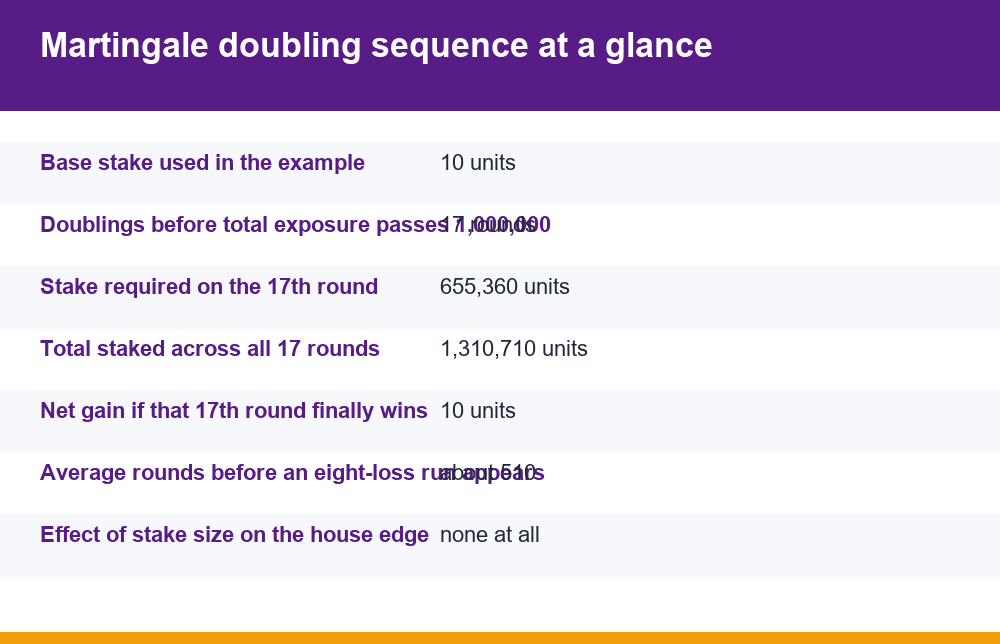
| 17 | 655,360 | 1,310,710 | 10 |
Seventeen consecutive losses on a 10-unit base stake require a seventeenth stake of 655,360 units, and carry total exposure past 1.3 million units. The reward for surviving all of it is 10 units. That is not a rhetorical flourish; it is the fourth column of the table, which never changes no matter how far the sequence runs.
Read the table in the other direction and the shape of the martingale strategy risks becomes obvious. Each additional round of bad luck doubles everything at stake while adding nothing whatsoever to the upside. A plan in which the downside compounds and the upside is a constant is not a strategy with a weak point. It is a strategy with only a weak point.
Scale the base stake and nothing improves — it just relabels the axis. A base of 100 units reaches the same structural wall roughly three rounds earlier in absolute terms, because the ceiling that stops the sequence is fixed while the stakes climbing toward it are ten times larger. Lowering the base stake buys a few more rounds of runway and reduces the per-cycle profit by the same factor, so the ratio of what is risked to what is earned is left untouched.
One detail in the table deserves a second look: the gap between the stake on a round and the total already staked. Early on the two are close, which is what makes short demonstration tables so persuasive — at round four you are 150 units in and the next stake is 80, a figure that still looks like a decision a person might make. By round fourteen you are 163,830 units in and the next stake is 81,920. Nothing about the plan has changed between those two points; only the scale has. The decision to continue is identical in structure at every round, which is precisely why there is no natural place in the sequence to stop.
How much bankroll a losing run actually demands
The requirement is exact. To survive n consecutive losses and still place the nth stake, a player needs the base stake multiplied by two to the power of n, minus the base. Ten rounds of a 10-unit base needs 10,230 units available. Thirteen rounds needs 81,910. The balance requirement grows exponentially while the earnings grow linearly, one base stake at a time.
Now the other half of the question: how often do such runs appear? For a fair even-money outcome, the average number of rounds you wait before seeing a run of k consecutive losses is two to the power of k plus one, minus two. The numbers are smaller than intuition suggests.
- A run of 5 consecutive losses: expected roughly every 62 rounds. Needs 310 units on a 10-unit base.
- A run of 8: expected roughly every 510 rounds. Needs 2,550 units.
- A run of 10: expected roughly every 2,046 rounds. Needs 10,230 units.
- A run of 13: expected roughly every 16,382 rounds. Needs 81,910 units.
- A run of 17: expected roughly every 262,142 rounds. Needs 1,310,710 units.
These are averages for a fair even-money outcome. Where the game carries a margin — and every real game does — the losing side is slightly more likely than the winning side, so every waiting time above shortens and every run becomes a little more frequent. On a wheel-style even-money bet with a single zero, the chance of the losing side is about 51.4 percent per round, and seventeen consecutive losses works out at roughly one sequence in 83,000 rather than one in 131,000. The direction of the correction is always the same: toward the bad outcome, never away from it.
Put the two halves together. A player with 2,500 units and a 10-unit base is, on average, a few hundred rounds from the run that empties the account. Those few hundred rounds will have produced a steady trickle of 10-unit wins — enough to feel like a method working — and the run at the end removes all of them plus the balance. Anyone comparing the two columns of their own record will see this long before the arithmetic is explained to them, which is the practical argument for keeping a record at all.
It is also worth noting what the word average is doing in those figures. An expected waiting time of 510 rounds does not mean the eight-loss run politely waits until round 510. Runs of that length turn up early about as readily as late, because the waiting time is spread very widely around its own average. A balance sized to the average is therefore a balance sized to roughly even odds of failing sooner, which is one of the quieter martingale strategy risks: the number people plan against is a midpoint, not a floor.
Table limits, ceilings and the moment the plan stops
Every real game has a maximum accepted stake per round. The doubling sequence needs the opposite: an accepted stake that can rise without bound. These two facts cannot both hold, so the sequence terminates — and it terminates at the worst possible moment, because the only time a player needs the largest stake is when they are already deepest in loss.
The arithmetic of a ceiling is unforgiving. Suppose the largest accepted stake is 1,000 times the base. Doubling from the base reaches that ceiling on round ten, which means a run of ten losses ends the sequence with 10,230 units gone and no permitted way to continue. The player is not stopped by running out of money. They are stopped by the rules of the round itself, holding a loss that the plan has no mechanism to recover.
The two ceilings — the per-round maximum and the player’s own balance — interact badly. Whichever is lower is the one that ends the sequence, and both are fixed while the stake requirement doubles toward them. There is no configuration of base stake, balance and limit in which the sequence is unbounded, because doubling outruns every finite number. The question is never whether the sequence will be cut short, only on which round.
This is also why the common variations do not help. Doubling only after two losses, doubling by less than two, capping the sequence at a fixed number of rounds and resetting, splitting the balance into several smaller sequences — each of these changes the shape of the distribution, trading a larger chance of a moderate loss for a smaller chance of a total one, or the reverse. None of them changes the expected result, because none of them touches the margin.
The margin is applied to every unit staked, and the arithmetic of why that holds is set out in our breakdown of how the house edge is built into every round. A staking pattern decides how the losses are distributed over time. It does not decide their total.
Two of the martingale strategy risks most often overlooked live at this boundary rather than in the numbers themselves. The first is that a player who meets the ceiling mid-sequence is left with a decision the plan never anticipated: accept the loss, or abandon the doubling rule and improvise. The second is that a cap on the sequence converts the plan into something it was never advertised as — a pattern that takes a moderate loss fairly often instead of a total one rarely. Neither of those is a repair. Both are simply the sequence meeting a wall it was designed to pretend does not exist.
Does doubling after a loss change the next round?
No. Not by any amount, in any direction. The size of a stake is information about the player, not about the game, and an independent round has no memory of what came before it. A wheel does not know it has landed on red six times; a shuffled or randomly generated outcome does not know it has gone against you; nothing in the mechanism reads the stake before producing the result.
The belief that it does is the gambler’s fallacy, and it is the emotional engine behind the doubling plan even for people who would reject the fallacy if asked directly. The reasoning goes: a seventh loss in a row is very unlikely, therefore this round is safer than usual. But the unlikely thing is the sequence of seven considered in advance. Standing at the start of round seven, six losses have already happened — probability one, they are history — and the only open question is the single round ahead, which carries exactly the same odds as the first one did.
This is the point at which most honest discussions of martingale strategy risks stop, and it is worth going one step further. The independence of rounds is not merely a technical caveat; it is the reason the plan cannot be rescued by observation. If outcomes were linked, patterns would carry information and staking could in principle respond to it. Because they are not linked, every pattern a player notices is a description of the past with no predictive content, and the spread of short-run results that creates those patterns is covered in our explainer on what variance does to short runs of play.
One more consequence follows. Since each round is independent and each carries the same margin, the expected loss on a sequence of rounds is simply the margin multiplied by the total amount staked. Doubling stakes does not reduce that total — it inflates it dramatically. A doubling player stakes far more units per hour than a flat-stake player at the same base, and therefore surrenders far more to the margin in the same period. The plan does not merely fail to beat the margin. It feeds it faster.
Why the losses dwarf the wins
The asymmetry is structural and can be stated in a sentence: the win is capped at one base stake and the loss is capped only by the balance. Every completed cycle returns the same tiny amount; every failed cycle returns everything the cycles before it produced, and then some.
This produces a distribution of results that is deeply misleading to look at from inside. Most sessions end slightly up. The typical outcome and the average outcome point in opposite directions — the typical result is a small gain, the average result is a loss — because a small number of very large negative results carry the mean down while leaving the common experience untouched. Any plan with this shape generates strong confidence for a long time and then settles the account in one movement.
It also distorts how progress gets read. A player a hundred cycles into a doubling plan is a thousand units ahead on a 10-unit base, and has every reason to describe the approach as working, because by the only measure they can see it is. What they cannot see is the liability sitting behind those hundred small wins: the outstanding exposure that one sufficiently long run will call in. The gains are realised and visible; the risk is unrealised and invisible until the moment it is not.
- The win is a constant. One cycle, one base stake, regardless of how many rounds or how much was risked.
- The loss is exponential. Each extra losing round doubles the exposure while the reward stays fixed.
- The frequencies are inverted. Small wins arrive often enough to build confidence; the large loss arrives rarely enough to feel like an injustice rather than a scheduled event.
- The totals reconcile. Across enough cycles the frequent gains and the rare loss cancel, and the margin applied to every unit staked decides the remainder.
Set out that way, the martingale strategy risks are not four separate problems but one problem counted four times. A constant reward, an exponential exposure, inverted frequencies and a margin on every unit are four descriptions of the same trade, and no adjustment to the staking rule can alter one of them without altering the others in the opposite direction.
Why the same maths applies to colour-prediction rounds
Colour-prediction formats present a near-even choice resolved in a very short round, and doubling plans circulate around them constantly — often repackaged with new names, sequence charts and talk of patterns about to break. The arithmetic is completely indifferent to the packaging. Any format offering a near-even outcome with a margin and a per-round ceiling produces precisely the table above.
The short round length makes matters worse rather than better. A plan that needs 510 rounds on average to meet an eight-loss run reaches those 510 rounds in a fraction of the time when each round resolves in under a minute. Compressing the clock does not reduce the number of rounds required for the bad run; it simply brings it forward. Fast rounds are the same arithmetic on a shorter fuse.
There is a further effect of speed that has nothing to do with probability. A round that resolves in under a minute leaves no interval in which to reconsider the next stake, and a doubling rule is designed to remove that decision anyway. The combination means the exposure can climb through several doublings in the time it takes to think about the first one. None of this changes the odds; it changes how many rounds get placed before anyone reads the total staked column.
The pattern charts that accompany these formats deserve specific mention, because they are the bridge between the doubling plan and the fallacy that sustains it. A chart of past colours is a record, and a record of independent outcomes contains no information about the next one — the gap between what those charts appear to show and what they can actually tell you is examined in our look at what colour-prediction result charts really show. A doubling plan reading from such a chart is not responding to evidence. It is responding to its own history.
Two further hazards sit around these formats and are worth naming plainly, because they are where real money is most often lost. The first is any pitch promising a sequence, signal or prediction service that makes the doubling plan safe — there is no such thing, and the arithmetic above is why. The second is recruitment of other people into a scheme, where returns are described as coming from a staking method but are in fact coming from new participants. Both mechanics are described here only so they can be recognised and avoided.
If play has stopped feeling like a choice, free and confidential help exists: BeGambleAware explains the risks in plain terms and lists where to get help. Real-money play is for adults, and across enough rounds losses are the expected outcome by design, not the result of a technique applied badly.
Mistakes to avoid and what records reveal
If you take nothing else from the arithmetic of martingale strategy risks, take the list of beliefs it rules out. Each of these appears repeatedly in material promoting doubling plans, and each is false for reasons given above rather than reasons of opinion.
- Treating the big loss as bad luck. It is the scheduled counterpart of the small wins, not an interruption of them.
- Believing a long run of losses makes the next round safer. Independent rounds carry identical odds every time.
- Assuming a larger balance fixes the plan. It buys a handful of extra rounds at exponential cost and leaves the margin untouched.
- Reading a sequence of past results as a signal. A record of independent outcomes predicts nothing about the next one.
- Judging the plan by session results. Most sessions end slightly up; that is the shape of the distribution, not evidence of an edge.
- Mistaking a modified sequence for a solved one. Varying the multiplier or capping the rounds redistributes losses without reducing them.
- Trusting anyone selling a version that works. The arithmetic is public, fixed and not improvable, so there is nothing to sell but the belief.
The one genuinely useful habit in this area is record-keeping, and it is useful precisely because it is unflattering. Write down every round: the stake, the outcome, the running total staked and the running net. Keep the total staked column in particular, because it is the number the margin is applied to and the number a doubling plan inflates fastest. A player who records only net position sees a gentle upward line punctuated by one cliff. A player who records total staked sees the liability accumulating all along.
Record the sequence length too. Every cycle has a length, and the lengths you have survived so far are a direct statement of the exposure you have been carrying without noticing. A log showing that your longest completed run was six rounds is also telling you that a seven-round run has simply not come up yet, and what the stake on it would have been.
None of this makes a doubling plan safer; nothing does. What an honest record does is close the gap between the arithmetic and the experience. The reason martingale strategy risks are so widely misunderstood is that the plan’s failure is invisible in the only data most players keep, and perfectly visible in the data they do not. The sequence doubles, the ceiling is fixed, the margin is applied to every unit, and all three of those facts were decided before the first round was placed.
Frequently Asked Questions
What is the martingale betting system?
It is a staking pattern, not a prediction method: you place an amount on a near-even outcome, double the stake after every loss, and return to the original base stake after a win. Because each doubled stake exceeds the sum of all previous stakes, a single win recovers every prior loss in the sequence and leaves exactly one base stake as profit. The pattern says nothing about which outcome to choose and does not alter the odds of any round — it only decides how much is risked next.
Why does the martingale strategy fail in the long run?
Because the downside compounds while the upside is a constant. Each additional losing round doubles the amount at risk, but the reward for completing the cycle stays at one base stake no matter how many rounds it took. Add a margin applied to every unit staked, and a doubling pattern simply stakes far more units per hour than flat staking does, surrendering more to that margin in the same period. The large loss is not an accident that spoils an otherwise sound plan; it is the exact counterweight that makes the frequent small wins possible.
How much bankroll does martingale need to survive a losing streak?
To place the nth stake after n-1 losses you need the base stake multiplied by two to the power of n, minus the base. On a 10-unit base that is 310 units to survive five losses, 2,550 to survive eight, 10,230 to survive ten, 81,910 to survive thirteen, and 1,310,710 to survive seventeen. The requirement grows exponentially; the earnings grow one base stake at a time. There is no balance large enough to make the sequence unbounded, because doubling outruns every finite number.
Do table limits stop the martingale system from working?
A per-round maximum ends the sequence at a fixed point, and it does so at the worst possible moment — the only time the largest stake is needed is when the player is already deepest in loss. If the maximum is 1,000 times the base, doubling reaches it on round ten, so a ten-loss run leaves 10,230 units gone with no permitted way to continue. The player’s own balance is a second ceiling working the same way; whichever is lower ends the sequence first. Both are fixed while the required stake doubles toward them.
Does doubling after a loss change the odds of the next round?
No, by any amount, in any direction. Stake size is information about the player, not about the game, and an independent round has no memory of the ones before it. The intuition that a seventh loss must be unlikely confuses two different questions: a run of seven considered in advance is unlikely, but once six losses have happened they are history, and the single round ahead carries exactly the same odds as the first one did. That is the gambler’s fallacy, and it is the emotional engine behind doubling plans.
Why are martingale losses so much bigger than the wins?
Because the win is capped at one base stake while the loss is capped only by the balance. Every completed cycle returns the same small amount regardless of how much was risked to get it; every failed cycle takes back the accumulated gains and the balance behind them. This produces a distribution in which the typical result is a small gain and the average result is a loss, since a few very large negative outcomes drag the mean down without touching the common experience. The plan therefore builds confidence for a long time and settles up in one movement.