The law of large numbers is probably the most misquoted idea in gambling. It is invoked to justify waiting for red after six blacks, and invoked again to explain why a system failed, and in both cases it is being asked to do something it does not do. The actual statement is narrow, provable and rather boring: as the number of trials grows, the average result converges on the expected value. What it does not say is that results balance out, that a deficit gets repaid, or that anything is due. Five lessons follow from the real version, and together they explain both why no system works and why the house does not need luck.
Table of Contents
What the law of large numbers actually says
Formally: as the number of independent trials increases, the sample average converges towards the expected value. Flip a fair coin enough times and the proportion of heads approaches one half.
Two words carry the weight. Average, not total. And independent, meaning each trial is unaffected by the ones before it. Remove either and the statement stops being true, and almost every misuse of the law comes from quietly dropping one of them.
The distinction that explains everything
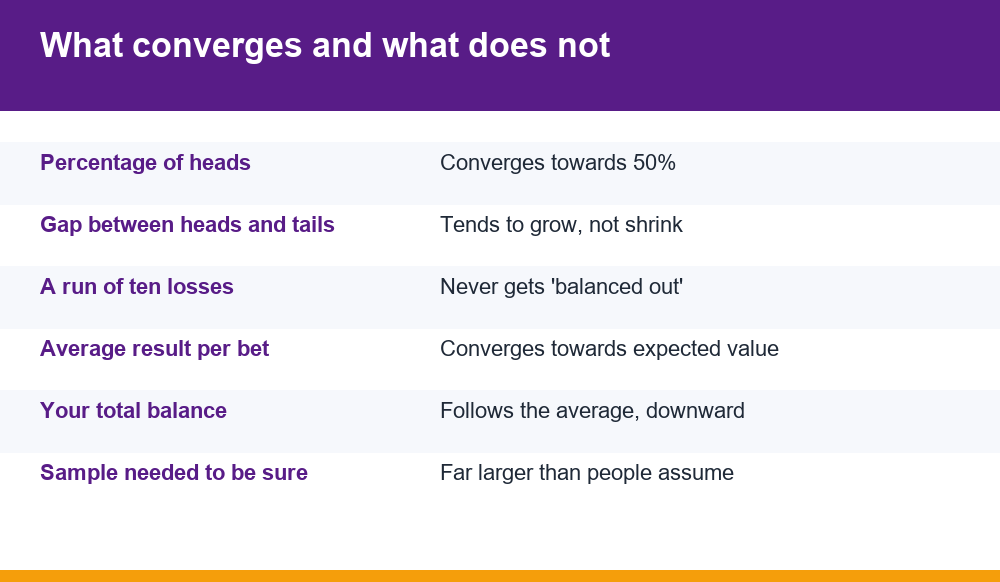
The percentage of heads moves towards 50 per cent. The raw difference between the number of heads and the number of tails does not move towards zero. It tends to grow. Those two facts sound contradictory and are not, and holding them together is the whole subject.
Lesson one: proportions settle, totals do not
Suppose after 100 flips you have 60 heads and 40 tails. Heads lead by 20 and the proportion is 60 per cent.
Flip 9,900 more times. The expected split of those is roughly even, so you might finish near 5,010 heads and 4,990 tails, giving 5,070 against 4,930 overall. The proportion has fallen from 60 per cent to about 50.7, which is convergence working exactly as advertised. The gap, meanwhile, has grown from 20 to 140.
The percentage settled because the denominator got enormous, not because anything corrected. Nothing pulled the sequence back. The early imbalance was simply diluted, and it is still sitting there.
This matters because your balance is a total, not a proportion. Convergence of the average does nothing to retrieve money already lost.
Lesson two: nothing is owed to you
The belief that a run of one outcome makes the other more likely is the gambler’s fallacy, and it is the direct consequence of misreading this law.
A fair coin that has landed heads eight times running has exactly a 50 per cent chance of heads on the ninth. The coin has no memory, no record of the sequence and no mechanism by which it could have one. Independence means precisely this.
The feeling that tails is overdue is strong and nearly universal, which is why it survives explanation. It is worth noticing that the same instinct also produces the opposite error: deciding heads is hot and backing it to continue. Both read meaning into a sequence that contains none.
- Eight heads in a row happens about once every 256 runs of eight. It is unremarkable.
- Pattern displays showing recent results exist to encourage this reading
- An outcome being rare over a long run says nothing about the next trial
- If results were genuinely due to balance out, the sequence would not be random
Lesson three: small samples prove nothing
The converse is equally important and much less discussed. If large samples converge, small samples scatter, and almost everything anyone observes personally is a small sample.
Forty rounds is not evidence of anything. A system that produced a profit over forty rounds, or a hundred, has demonstrated nothing beyond that variance exists. This is how testimonials are generated without anyone lying: out of enough people trying a system, some will be ahead, and those are the ones who post about it.
| Trials | What you can reasonably conclude |
|---|---|
| 10 | Nothing at all |
| 100 | Very little. Wide swings are normal. |
| 1,000 | A rough sense, still easily misled |
| 10,000+ | The average is becoming meaningful |
The uncomfortable implication is that by the time your own experience constitutes real evidence about a negative-expectation product, you have paid a great deal for the data.
Lesson four: the house needs volume, not luck
This law is the entire foundation of the industry, and it is worth stating plainly because it reframes what is happening.
An operator does not need to win any particular round. It needs enough rounds. With a small edge and a very large number of trials, the operator’s results converge tightly on the expected value, while each individual player stays in the high-variance zone where anything can happen.
The two sides of the same table are therefore in completely different statistical situations. The operator is effectively in the long run permanently; the player is almost never there. That asymmetry, not any trickery, is the business.
It also explains why operators are relaxed about large individual wins. A payout that would change a person’s year is a rounding error against the volume, and it advertises well.
Lesson five: speed decides when the law arrives
Nothing in the mathematics mentions time. It counts trials. Which means the practical question is how quickly a product can generate them, and that varies enormously.
A weekly accumulator produces 52 trials a year. Someone could play for a decade and remain comfortably inside the range where luck dominates. A thirty-second round produces 120 an hour, so a few evenings a week reach a thousand trials inside a month.
Same mathematics, completely different experience. The fast product delivers the long run quickly, which is why the edge shows up as a reliable drain rather than an abstraction. Speed is the variable that converts a theoretical margin into an actual one, and it is the thing to look at first on any product.
We worked through how that margin is set in the first place in our piece on variance and what it hides, which is the other half of this picture.
How the law gets misused in both directions
The familiar misuse is the gambler’s fallacy. The less familiar one is more interesting, because it is committed by people who think they have understood the maths.
That version runs: since the average converges to the expected value, and my system has a positive expected value, I am guaranteed to profit eventually. The flaw is the word eventually. Convergence says nothing about how long it takes or how deep the drawdown gets on the way, and a bankroll can be gone long before the average asserts itself.
This is the formal reason doubling systems fail. They have a positive-looking record precisely because they win small and often, and the rare catastrophic loss arrives before any long run is reached. The law is not violated; it simply never gets the chance to apply.
There is also a quieter misuse in the other direction: treating a genuinely large sample as still being luck. If a product has taken money from a million players over a million rounds, that is not variance and calling it bad luck is as wrong as calling eight heads a pattern.
The same law, working for insurers
It is worth seeing the law of large numbers used somewhere other than gambling, because the comparison clarifies what is actually happening at a betting product.
An insurer has no idea whether your house will flood. The individual case is unpredictable in exactly the way a single round is. What the insurer knows is the rate across hundreds of thousands of houses, and across that volume the average claim cost is remarkably stable. The premium is set from that average plus a margin, which is structurally identical to a payout set below true odds.
The difference is what the customer gets. An insurance customer is buying the removal of a risk they did not want, and paying a margin for the service. A player is buying the addition of a risk they chose, and paying a margin for it. The mathematics is the same; the direction of the benefit is opposite.
That comparison also disposes of the idea that an operator profiting reliably implies dishonesty. Insurers profit reliably from unpredictable individual events without anyone suggesting the floods are fixed. Volume plus a margin is sufficient, and it is all that is happening here.
What follows practically
Four things follow for anyone who plays, and none of them is a system.
- Stop reading sequences. Previous results carry no information about the next trial on an independent game.
- Distrust your own sample. A good month is forty data points and proves nothing about the product.
- Treat speed as the main risk factor, ahead of stake size. Volume is what brings the average down on you.
- Judge the terms, not the outcomes. The margin is knowable in advance; your results are not.
The last point is the useful one. Because the law of large numbers guarantees convergence to the expected value, and because the expected value is set by the payout terms rather than by anything that happens during play, the only question that matters can be answered before a single round is played.
That is a genuinely liberating conclusion, if an unglamorous one. There is nothing to work out in the moment, no sequence to read and no skill to develop. The arithmetic was settled when the payout table was written, and everything after that is variance taking its time.
One caveat worth attaching to all five lessons. Everything above assumes trials are independent and the probabilities are fixed, which holds for a coin, a wheel and a properly specified generator. It does not hold for games involving skill, nor for markets where the odds move because other people are betting, nor for any product where the operator can alter the terms between rounds. Checking that the assumption applies before applying the conclusion is the one piece of diligence the mathematics cannot do for you.
And the broader point survives the caveat. Wherever trials genuinely are independent and the payout sits below true odds, the law guarantees the direction of travel. It cannot tell you when, it cannot tell you how bumpy the route will be, and it offers no comfort about tonight. What it does provide is certainty about the destination, which is more than most things in this area can claim.
Frequently Asked Questions
Does the law of large numbers mean results even out?
No, and this is the central misreading. The proportion converges towards the expected value because the sample grows, not because anything corrects. The raw gap between outcomes tends to widen over time, and money already lost is never recovered by convergence.
If red has come up ten times, is black more likely?
No. On an independent game each trial is unaffected by previous ones, so the probability is unchanged. This is the gambler’s fallacy, and it follows directly from confusing the long-run proportion with some mechanism that balances short sequences.
How many bets before my results mean something?
Far more than most people assume. A hundred trials still scatter widely, and a thousand gives only a rough sense. Meaningful conclusions generally need tens of thousands, which is why personal experience is a poor guide to whether a product or system works.
Why does the house always win if each round is random?
Because the operator experiences a vast number of trials and converges on the expected value, while each player experiences few and stays in the range where luck dominates. A small edge applied to enormous volume is reliable income without any round being rigged.
Can a positive expected value system still lose?
Yes, and frequently. Convergence says nothing about how long it takes or how severe the losing stretch is beforehand. A bankroll can be exhausted well before the long run arrives, which is the formal reason doubling systems eventually fail.